
Processes · 4 min read
Common defects in bronze and brass castings and how to prevent them
The most common defects in bronze and brass castings, what causes them, how they are detected and what to specify at the enquiry stage to prevent them.
Conex Casting Foundry · 17 Nov 2026
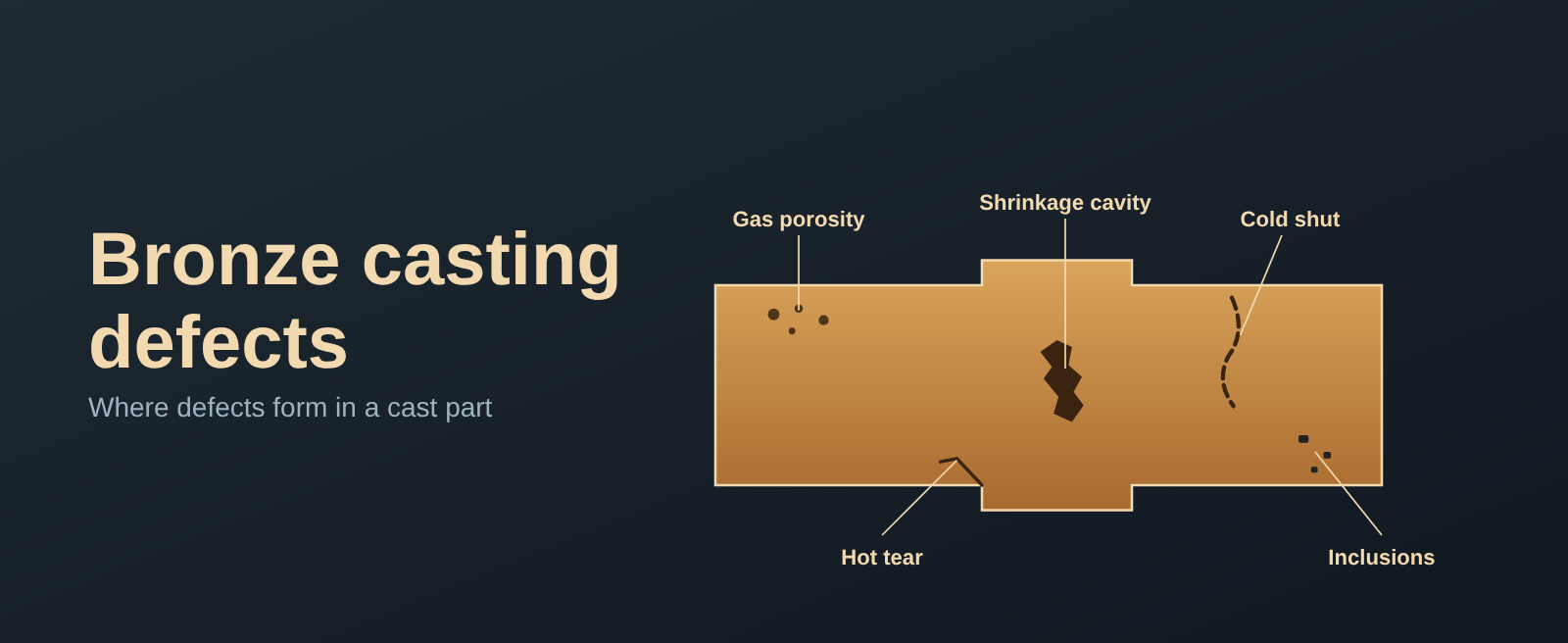
Bronze casting defects are the reason a casting that looks perfect on the outside can still leak under pressure or crack in service. Most failures trace back to a small group of defects, and nearly all of them can be prevented when the design, the alloy and the foundry practice are right. This guide explains the defects we see most often in bronze and brass castings, what causes them and what you can do at the enquiry stage to avoid them. If you are still choosing a material, start with our guide to choosing a casting alloy.
1. Gas porosity in bronze castings
Small round holes, often just under the surface, are usually caused by dissolved gas that cannot escape as the metal freezes. Copper alloys pick up hydrogen from moisture in the charge, the mould or the furnace atmosphere. Prevention starts with dry, clean charge material, controlled melting temperature, degassing before the pour and well-vented moulds and cores.
2. Shrinkage porosity
Metal shrinks as it turns from liquid to solid. If a thick section is not fed with liquid metal while it freezes, a rough, jagged cavity forms inside it. Tin bronzes such as C90500 and SAE 660 bearing bronze freeze over a wide range and are especially prone to this. The fix is good feeder (riser) design, chills in heavy sections and, where possible, a casting design with even wall thickness.
3. Misruns and cold shuts
A misrun happens when metal freezes before it fills the mould. A cold shut is a seam where two streams of metal meet but do not fuse. Both come from pouring too cold, too slowly or through poor gating, and thin walls make them more likely. Correct pouring temperature, a well-planned gating system and a minimum wall thickness suited to the process keep them under control.
4. Inclusions and dross
Oxide films, slag and sand particles carried into the mould show up as hard spots, rough machined faces or leak paths. Aluminum bronze forms oxide skins very quickly, so it needs careful, quiet pouring. Skimming the melt, using ceramic filters and designing the gating to avoid turbulence all reduce inclusions.
5. Hot tears and cracks
When a casting is restrained by the mould while it cools, stress can tear it apart at sharp corners or where thick and thin sections meet. Generous radii, gradual changes in thickness and a mould that can yield as the metal contracts are the usual remedies.
6. Sand-related surface defects
Burn-on, rough surfaces and sand holes come from mould material fusing to the casting or washing into it. The right sand grade, mould coating and compaction matter here. If you need a smoother as-cast finish or tighter tolerances, investment casting is often a better route than sand casting; our guide to sand, investment and centrifugal casting explains the trade-offs. For dense, low-porosity rings and sleeves, centrifugal casting is the usual choice.
Why bronze casting defects matter to buyers
Bronze casting defects rarely stay cosmetic. A pore that is invisible at inspection can open into a leak path after machining, and a shrinkage cavity in a bearing or valve body can cause rejection or field failure. This is why bushes, bearings and wear plates are usually centrifugal or continuous cast. Because bronze and brass parts often go into pumps, valves, marine fittings and electrical equipment, a single defective batch can mean costly downtime. Understanding the main bronze casting defects helps you write a better specification and ask the right questions when comparing suppliers.
How bronze casting defects are found
Visual and dimensional checks catch surface problems. For hidden defects there are several options: pressure or leak testing for valve and pump parts, dye penetrant testing for surface cracks, radiographic (X-ray) inspection for internal porosity, and sectioning of sample castings during first-article approval. Chemical analysis and mechanical tests on test bars confirm that the alloy meets the specified grade. You can read how we inspect parts on our quality and testing page. If your drawing uses a different standard, our grade equivalents guide and the alloy equivalents chart show how the designations compare.
What you can do at the enquiry stage
Many defects are designed in rather than poured in. Share the working pressure and the critical faces so we can place feeders and machining allowance correctly. Avoid abrupt changes in section thickness, add radii at internal corners and state clearly which tests and certificates you need, because these decide the process and the cost. Our engineers will review your drawing and suggest changes that improve soundness without affecting function.
Not sure what your part needs? See our guide on what to include in a casting enquiry, or send your drawing through our quote request page and we will advise on the right alloy, process and testing plan.