
5 alloys
Investment Casting
Lost-wax casting for complex, near-net-shape parts with fine detail and the best as-cast finish — made through our partner foundry under Conex quality control.
Investment Casting — complete guide
At Conex, investment castings are made through our partner foundry, under our own quality control and inspection; all other casting processes run in our own foundry in Jamnagar.
Investment casting — the lost-wax process — makes complex, near-net-shape metal parts with fine detail, thin walls and the best as-cast surface finish of any casting process. A wax copy of the part is coated in ceramic, the wax is melted out, and molten metal is poured into the hot ceramic shell. At Conex Casting Foundry we investment cast stainless steel, bronze, brass and other alloys for pump impellers, valve components, instrument parts, marine hardware and defence fittings, and machine them in-house to your drawing.
This guide explains each step of investment casting, the materials involved, which alloys and parts suit it, what tolerances and finish to expect, how to design for it, and how it compares with shell molding, sand and die casting.
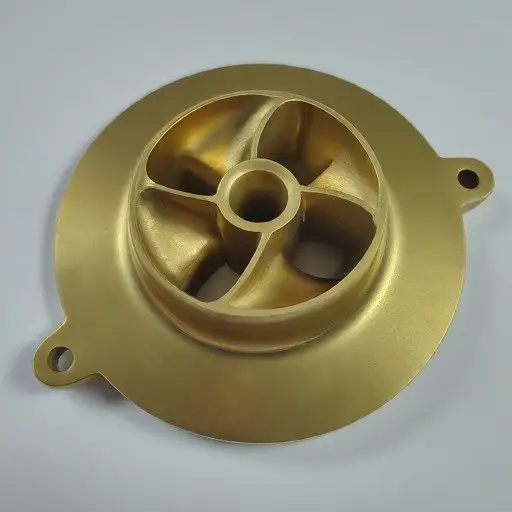
What is investment casting?
Investment casting takes its name from the ceramic "investment" that surrounds the wax pattern. It is one of the oldest metal-forming techniques — artisans used lost-wax casting for bronze statues and jewelry thousands of years ago — and it is also one of the most precise modern manufacturing processes, used for turbine blades, medical implants and precision valve parts.
Its key advantage is that the pattern is destroyed to release the mold, rather than being drawn out of it. That means there are no parting lines, no draft requirement on most surfaces and no need for the shape to release from a mold: undercuts, internal passages and complex 3D forms can be cast as one piece. Assemblies that would otherwise be machined from several parts and welded together can often be investment cast as a single component.
How investment casting works — step by step
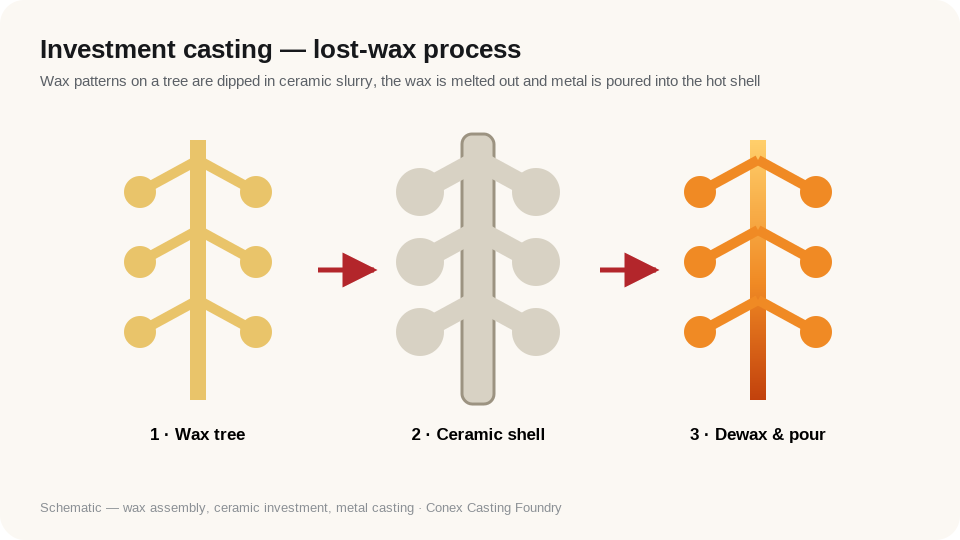
- Wax die (tool) making. An aluminum or steel die is machined with the shape of the part, enlarged to allow for the shrinkage of both wax and metal.
- Wax injection. Pattern wax is injected into the die to make an exact wax copy of the part. Soluble or ceramic cores can be added for internal passages.
- Tree assembly. Wax patterns are attached to a wax runner system — the "tree" — so that many parts are cast in one pour.
- Shell building. The tree is dipped in a ceramic slurry, coated with fine refractory sand ("stucco") and dried. The first coats use very fine materials to reproduce detail; later coats use coarser backup materials for strength. Typically six to nine coats are applied, with controlled drying between each.
- Dewaxing. The shell is placed in a steam autoclave or flash furnace; the wax melts and drains out, leaving a hollow ceramic mold. The wax is reclaimed.
- Firing. The shell is fired at high temperature — commonly around 900–1,100 °C — to burn out residual wax, strengthen the ceramic and pre-heat it for pouring.
- Pouring. Molten metal is poured into the hot shell. Because the shell is hot, metal flows into thin sections and fine details before freezing.
- Knock-out and cut-off. When the metal has cooled, the ceramic is broken away by vibration and blasting, and the parts are cut from the tree.
- Finishing. Gate stubs are ground, parts are heat treated where required, blasted or polished, machined and inspected.
Wax, cores and 3D-printed patterns
The precision of an investment casting starts with its wax pattern. Pattern waxes are blended for low shrinkage, good surface reproduction and clean melt-out; they are injected under controlled temperature and pressure so that every pattern has the same dimensions. Patterns are inspected before assembly — any flaw in the wax will appear in the metal.
Internal passages that cannot be formed by the wax die itself are made with soluble wax cores (dissolved out of the pattern before investing) or ceramic cores (left in the shell and removed chemically after casting). Ceramic cores make it possible to cast closed impellers, internal flow passages and cooling channels that could never be machined.
For prototypes and small batches, the wax die can be skipped altogether: patterns are 3D printed in castable resin or wax and invested in the same way. This lets you test a design in the real alloy within weeks, and move to an injection die once the design is frozen and volumes justify it.
The ceramic shell
The shell must be strong enough to hold the molten metal, permeable enough to let gases escape, smooth enough on its inner face to give a fine surface, and weak enough after casting to be knocked away. It is built in layers:
- Prime coats — a fine slurry (typically colloidal silica with zircon flour) and fine stucco reproduce every detail of the wax and form the casting surface.
- Backup coats — coarser slurries and alumino-silicate stucco build strength and thickness.
- Drying between coats — each coat must dry fully under controlled humidity and air flow; rushing this step is the most common cause of shell cracking.
- Seal coat — a final slurry coat locks the outer stucco in place.
Shell building is the slowest part of the process — typically several days for a full shell — which is why investment casting lead times are longer than for sand or die casting.
Why buyers choose investment casting
- Complex shapes in one piece — undercuts, internal passages, thin vanes and intricate 3D forms.
- Close tolerances — typically ISO 8062-3 DCTG 4–6, the best of any casting process.
- Excellent surface finish — around Ra 1.6–3.2 µm as cast, often good enough for visible surfaces.
- Thin walls — down to about 1–1.5 mm.
- Near-net shape — minimal machining, so less metal waste — valuable with stainless steel and other costly alloys.
- Wide alloy choice — almost any alloy can be investment cast, including stainless and high-temperature grades.
- No parting line on most surfaces, and fine details such as logos and part numbers reproduce crisply.
Alloys we investment cast
| Alloy family | Typical grades | Typical parts |
|---|---|---|
| Austenitic stainless steel | CF8 (304), CF3 (304L), CF8M (316), CF3M (316L) — ASTM A351 / A743 / A744 | Pump impellers, valve parts, marine and food-equipment fittings |
| Martensitic stainless steel | CA15 (410 type) | Valve trim, wear parts |
| Tin and silicon bronze | C90500, C87600 | Instrument parts, marine fittings, decorative parts |
| Aluminum bronze | C95400, C95500 | Wear-resistant valve trim, defence fittings |
| Brass | Yellow and silicon brasses | Detailed fittings, instrument bodies |
See full composition and property data in the alloy library.
Accuracy, finish and size
| Characteristic | Typical investment-casting value |
|---|---|
| Dimensional tolerance (ISO 8062-3) | DCTG 4–6 |
| Example: a 25 mm dimension | about ±0.1 to ±0.25 mm as cast |
| Surface roughness | Ra 1.6–3.2 µm |
| Minimum wall | about 1–1.5 mm |
| Draft | Usually none needed |
| Machining allowance | 0.5–1 mm on faces that are machined |
| Typical weight | a few grams to about 25–50 kg |
For best economy, keep investment-cast parts in the small-to-medium size range. Very large parts are usually more economical by sand or shell molding.
Designing parts for investment casting
- Uniform sections remain the golden rule: heavy sections next to thin ones cause shrinkage.
- Radii at internal corners of at least 0.5–1 mm help metal flow and strength.
- Hole sizes: through-holes down to a few millimeters can be cast; blind holes should be shallower than their diameter, or drilled after casting.
- Combine parts: review assemblies for pieces that could be cast as one, eliminating welding or fasteners.
- Datums: specify datum features, so we can design the gating away from them and use them for machining.
- Logos and markings can be cast in at no extra cost.
Before you send the drawing
A few details help us quote an investment casting accurately and quickly: a 3D model (STEP or IGES) as well as the 2D drawing, the alloy standard (for example ASTM A351 CF8M), annual quantity and batch size, which features are machined and which stay as cast, required surface finish, heat treatment and testing, and the documents you need with each shipment. If you are converting a machined or fabricated part to a casting, send the current drawing too — we will suggest where the casting can be simplified or combined.
Investment casting compared with other processes
| Investment | Shell molding | Sand casting | High-pressure die | |
|---|---|---|---|---|
| Tolerance | DCTG 4–6 | DCTG 8–10 | DCTG 9–12 | DCTG 5–7 |
| Surface Ra | 1.6–3.2 µm | 3.2–6.3 µm | 6.3–25 µm | 0.8–3.2 µm |
| Complexity | Highest | Medium | High (cores) | Medium |
| Alloys | Almost any, incl. stainless | Most | Almost any | Aluminum, zinc, brass |
| Tooling cost | Medium–high | Medium | Low | Highest |
| Lead time per batch | Longer (shell drying) | Short | Short | Very short |
Quality control
Investment casting has many steps, and each must be controlled. Our ISO 9001:2015 system covers wax injection parameters and pattern inspection, slurry viscosity and drying conditions between coats, dewax and firing temperatures, melt chemistry by spectrometer, and pouring temperature. Finished castings are visually inspected, dimensionally checked and — where specified — dye-penetrant, radiography or pressure tested. Stainless castings are solution annealed and pickled for corrosion resistance where the standard requires it. Each consignment ships with a material test certificate and inspection report.
| Defect | Cause | Prevention |
|---|---|---|
| Shell cracking | Wax expansion during dewax, weak shell | Flash dewax, shell thickness control |
| Inclusions | Ceramic breaking off, dirty metal | Clean shells, filters, careful pouring |
| Shrinkage | Heavy sections not fed | Gating design, tree layout |
| Misruns in thin walls | Shell or metal too cold | Pour into hot shell, temperature control |
Heat treatment and finishing of stainless castings
Austenitic stainless steel castings such as CF8M are normally solution annealed after casting: heated to a high temperature and quenched, which dissolves chromium carbides and restores full corrosion resistance. Standards such as ASTM A351 and A743/A744 specify this treatment. After heat treatment, castings are blasted and then pickled and passivated to remove scale and form a clean, protective oxide layer. Martensitic grades such as CA15 are hardened and tempered to the required hardness.
Finishing options include shot or bead blasting for a uniform matt surface, vibratory finishing, polishing to a bright or mirror finish for food and marine applications, and electropolishing. Functional features — bores, threads, sealing faces — are machined on our CNC machines and inspected to your drawing.
Worked example: a CF8M closed impeller
A pump manufacturer needs a 200 mm closed impeller in CF8M (cast 316) for a chemical-transfer pump, 1,500 pieces a year, with thin vanes and a smooth passage surface for efficiency.
- Route: investment casting with a ceramic core forming the enclosed vane passages — impossible to machine and difficult in sand.
- Tooling: an aluminum wax die for the impeller and a core die for the ceramic core; first patterns 3D printed to prove the design while the dies were made.
- Casting: four impellers per tree; shells built with zircon prime coats for a fine passage surface; metal poured into the hot shell to fill the thin vanes.
- Post-cast: core leached out, solution annealed, pickled and passivated; hub bored and keyed on CNC; dynamically balanced.
- Quality: chemical analysis of each heat, dye-penetrant testing of vanes, dimensional report and material certificate with every lot.
The impeller arrived with accurate vane geometry, a smooth hydraulic passage and minimal balancing correction — improving pump efficiency compared with the customer's previous sand-cast version.
Typical investment-cast parts
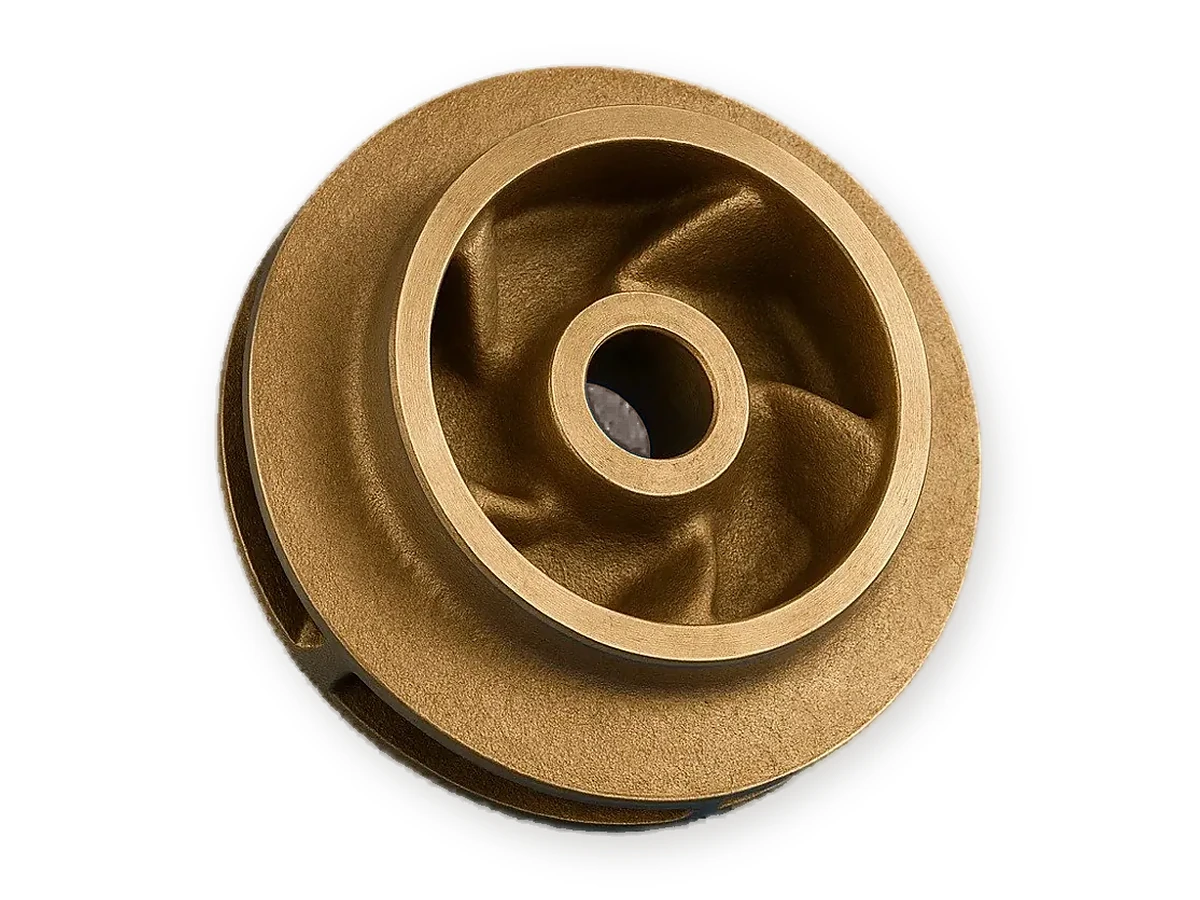
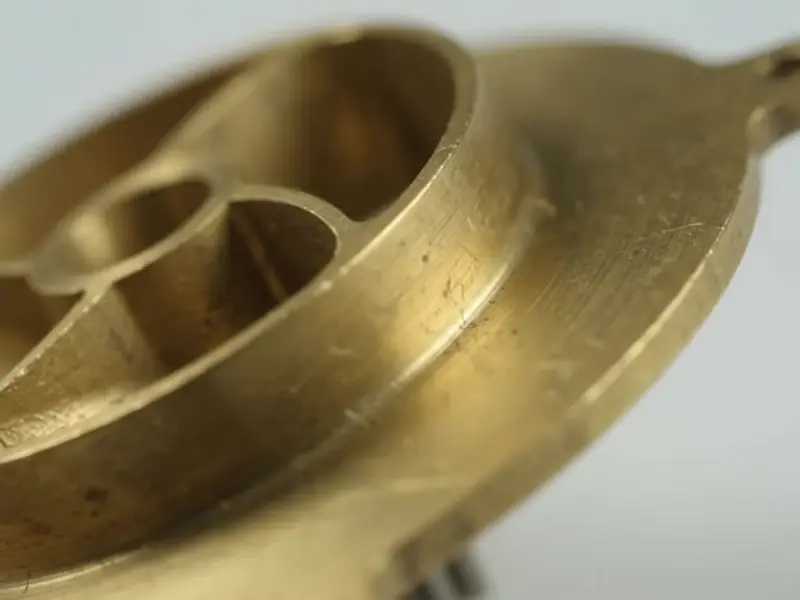
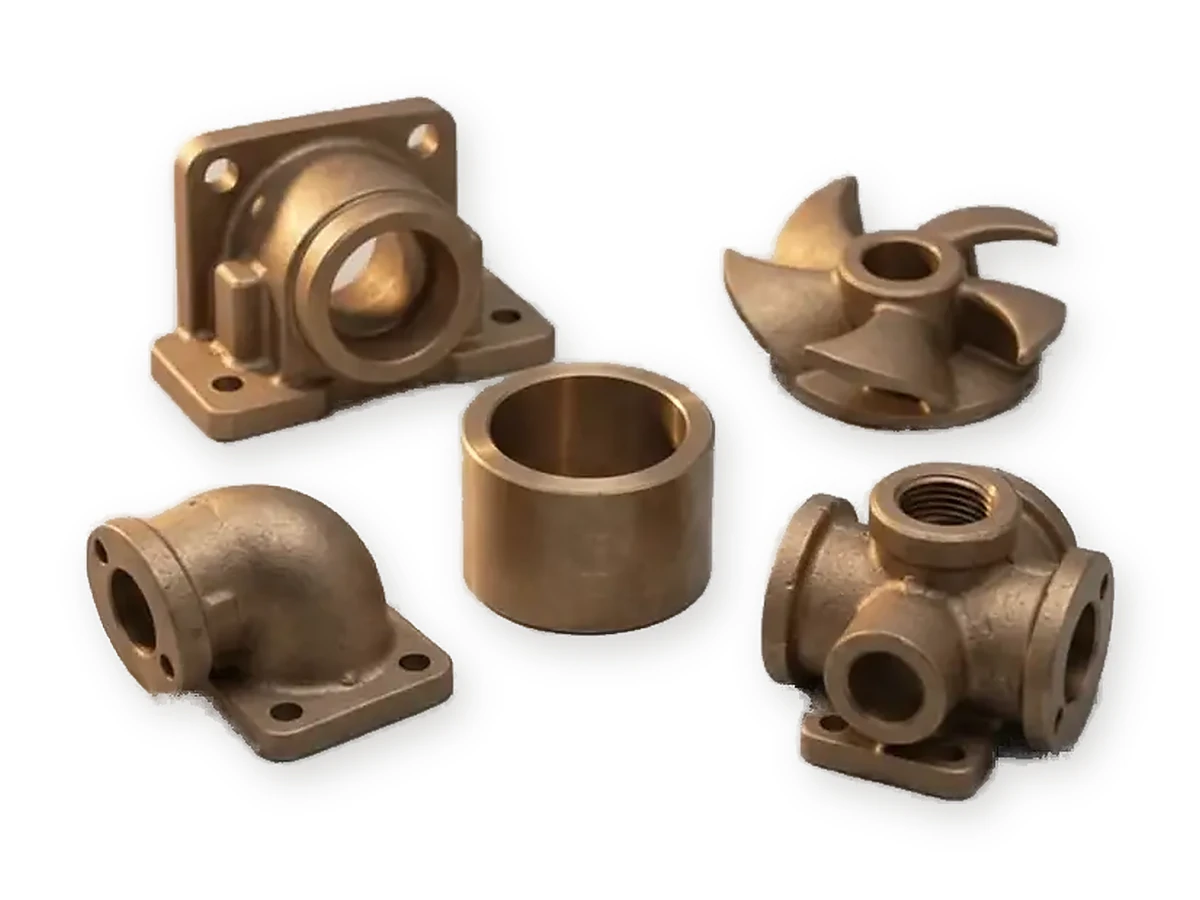
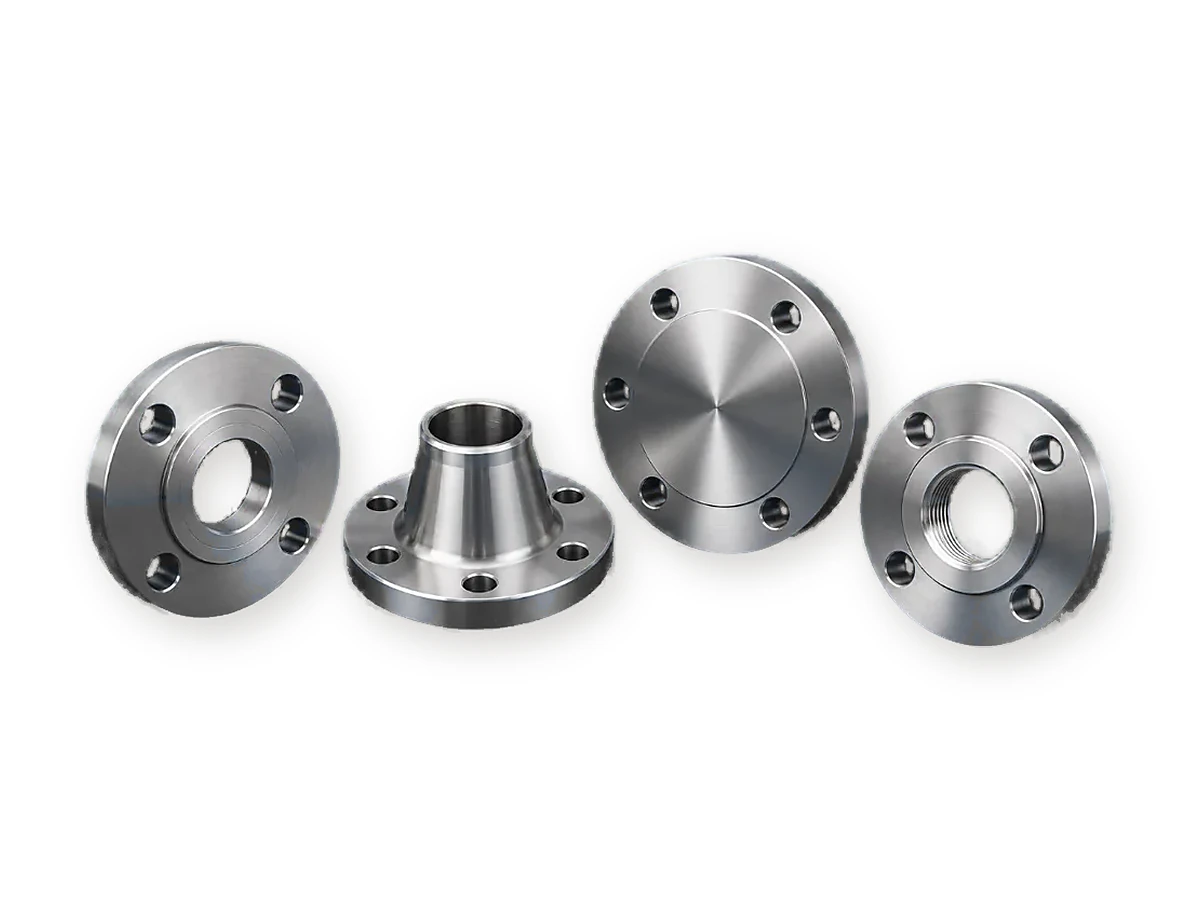
Typical applications include impellers and vanes, valve discs and trim, instrument and meter parts, defence and aerospace fittings, marine hardware and food-processing components — for pumps and valves, defence and aerospace, instrumentation, marine and food and beverage customers.
From ancient bronzes to precision engineering
Lost-wax casting is among the oldest metalworking techniques known: bronze figures cast by this method in the Indus Valley, Egypt and China are thousands of years old, and the craft has been practised in India continuously ever since. The industrial process developed in the twentieth century, first for dental and jewelry work and then, during the 1940s, for aircraft engine parts that could not be machined economically. Today it is used for everything from turbine blades and medical implants to pump impellers and marine fittings — wherever complex geometry, fine detail and close tolerances must come together in one part.
When investment casting is — and is not — the right choice
Investment casting is the right choice when a part is small to medium in size, complex in shape, needs close tolerances or a fine surface, and would otherwise require a lot of machining or the assembly of several pieces. It is especially valuable for stainless steel, where machining is slow and the metal is costly.
It is usually not the right choice for large, heavy, simple parts — where sand casting is far cheaper — or for very high volumes of small parts in aluminum, brass or zinc, where pressure die casting is faster. For small and medium parts that need a better finish than sand but not the full precision of investment, shell molding often gives the best value. Because we offer all of these, we will tell you honestly which route suits your part.
Cost and lead time
Investment casting has a higher cost per kilogram than sand casting because of the wax, ceramic and labor involved — but it often has a lower cost per finished part for small complex components, because machining and assembly are reduced or eliminated. The wax die is a one-time cost. New parts typically take 5–8 weeks from drawing approval to first samples, including tool making and shell building; repeat batches follow your schedule.
Investment casting — quick answers
What is the difference between investment casting and lost-wax casting?
None — they are two names for the same process.
Can you investment cast from a 3D-printed pattern?
Yes. For prototypes and very small quantities, patterns can be 3D printed and invested without a wax die, which lets you test a design before investing in tooling.
Is investment casting good for stainless steel pump impellers?
Yes — it is the preferred route for small and medium closed impellers, giving accurate vanes, a smooth surface and good balance.
Do investment castings need machining?
Usually only on functional features — bores, threads and sealing faces. Many surfaces can stay as cast.
How many parts can be cast on one tree?
From a single large part to dozens of small parts, depending on size. More parts per tree means lower cost per part.
Is investment casting suitable for bronze?
Yes. Tin, silicon and aluminum bronzes are investment cast for detailed instrument, marine and decorative parts where sand casting cannot give the detail or finish.
Request a quotation
Send your drawing or 3D model, alloy, quantity and finish requirements through our quotation form or WhatsApp. We will confirm whether investment casting or shell molding gives the best value for your part, and quote clearly.
Alloys we cast by investment casting
● dedicated pages first.
Other processes
Industries served
Product families made by investment casting
Questions buyers ask
What tolerances can investment casting hold?+
Typically ISO 8062-3 DCTG 4–6 — roughly ±0.1 to ±0.25 mm on a 25 mm dimension, before any machining.
What is investment casting?+
Lost-wax casting: a wax pattern is coated in ceramic, the wax melted out and metal poured into the shell, giving fine detail and an excellent finish.
When should I choose investment casting?+
For complex, precise parts such as impellers and small valve components where it reduces or removes machining.
Send your drawing, get a quotation.
DWG, PDF, STEP or a sample photo — with quantity and destination port.