
27 alloys
Sand Casting
Green sand, no-bake (resin) and CO₂ molding for parts from a few hundred grams to heavy pump casings — the most flexible route, with low tooling cost.
Sand Casting — complete guide
Sand casting is the most versatile way to make a metal part. A pattern shaped like the finished component is pressed into specially prepared sand to form a cavity, molten metal is poured in, and once the metal has solidified the sand is broken away. At Conex Casting Foundry in Jamnagar we sand cast bronze, brass, gunmetal, aluminum bronze, copper, copper-nickel and stainless steel parts from a few hundred grams to heavy pump casings — and then machine and inspect them in-house, so you receive a finished component rather than a rough casting.
This guide explains how sand casting works, which alloys and sizes suit it, what tolerances and surface finish to expect, how to design a part so it casts soundly, how we control quality, and when another process — shell molding, gravity die, investment or centrifugal casting — would serve you better.
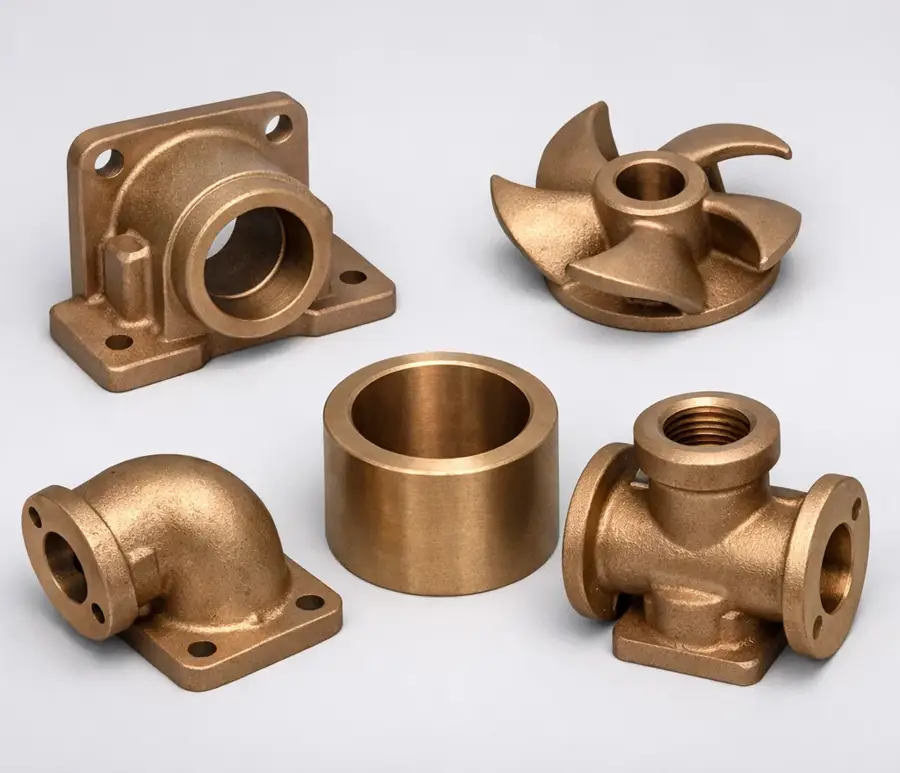
What is sand casting?
Sand casting (also called sand molded casting) is an expendable-mold process: every casting needs a new mold, but the pattern that forms the mold is reused thousands of times. The mold is made in two halves held in boxes called flasks — the upper half is the cope and the lower half the drag. Hollow features such as the bore of a valve body or the water passage of a pump casing are formed by sand cores placed inside the mold before it is closed.
Because sand is cheap, refractory and easy to shape, the process has almost no limits on part size, shape or alloy. That is why sand casting remains the backbone of the non-ferrous foundry industry, and why most valve bodies, pump casings, impellers, marine fittings, flanges and heavy bushes in the world are still sand cast.
In standards, sand castings are identified by their own specifications. In the USA, ASTM B584 covers copper-alloy sand castings for general applications, ASTM B62 covers composition bronze (85-5-5-5 / C83600) castings, ASTM B763 covers copper-alloy sand castings for valve applications and ASTM B148 covers aluminum-bronze sand castings. In Europe, EN 1982 designates sand-cast copper alloys with the suffix -GS (for example CC491K-GS). We cast to whichever standard is called up on your drawing.
How sand casting works — step by step
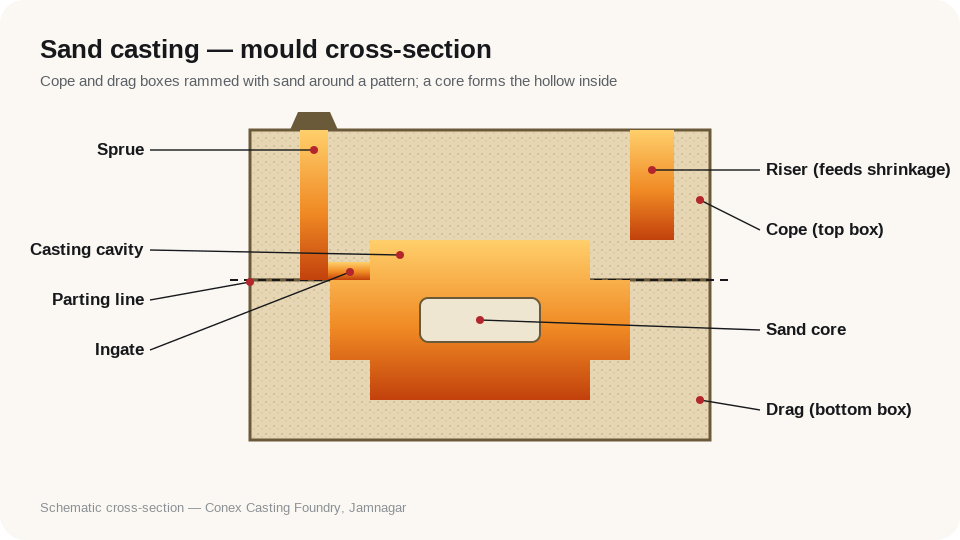
- Drawing review and method design. Our engineers study your drawing and decide the parting line, where the cores go, how metal will flow into the cavity (the gating system) and where risers are needed to feed shrinkage. Machining allowances are added to faces that will be machined.
- Pattern and core box making. The pattern is made slightly larger than the part to allow for metal shrinkage — typically 1.3–1.6% for brasses and tin bronzes and around 2% for aluminum bronze. Patterns are made in wood, resin or aluminum depending on quantity. Our in-house tooling department keeps this step fast and inexpensive.
- Molding. Sand is rammed around the pattern in the drag, the flask is turned over, the cope is rammed on top, and the pattern is withdrawn to leave a precise cavity. We use green sand (clay-bonded) for most work and chemically bonded no-bake sand for larger or more demanding parts.
- Core setting and closing. Sand cores, baked or chemically hardened so they hold their shape, are placed in the drag. The cope is lowered on top and the two halves are clamped or weighted.
- Melting and pouring. The alloy is melted in an induction furnace to the composition on your drawing, checked, de-gassed and poured at a controlled temperature — typically 1,100–1,250 °C for bronzes and gunmetals, and lower for brasses.
- Cooling and knock-out. The casting solidifies in the mold; the sand is then shaken out and returned for reconditioning.
- Fettling. Sprues, risers and gates are cut off, parting-line flash is ground away and the casting is shot blasted.
- Machining and inspection. The casting is machined on our CNC lathes and machining centers, then inspected against your drawing before export packing.
Types of sand molding we use
Green sand
Silica sand bonded with bentonite clay and a little water. It is the fastest and most economical method and suits the majority of small and medium bronze and brass castings. See our dedicated page on green sand casting.
No-bake (resin) sand
Sand mixed with a resin and catalyst that hardens at room temperature. The molds are rigid and dimensionally stable — ideal for larger parts, heavier sections and castings that must be pressure-tight.
CO₂ / silicate sand
Sodium silicate-bonded sand hardened with carbon dioxide gas. Used mainly for cores and for parts where fast mold hardening and good collapsibility are needed.
Alloys we sand cast
Almost every copper-base alloy can be sand cast, which is a big reason for the process's popularity. The most common sand-cast grades at Conex are:
| Alloy family | Typical grades | Why buyers choose it |
|---|---|---|
| Gunmetal / red brass | C83600 (85-5-5-5, LG2), C83800, C84400, LG4, CC491K | Pressure tightness, easy machining, valves and pump parts for water |
| Tin and phosphor bronze | C90300, C90500, C90700, PB1, PB2, CC480K, CC483K | Strength, wear and corrosion resistance — gears, bearings, marine parts |
| Leaded tin bronze | C93200 (SAE 660), C93500, C93700, LB2 | Bearings and bushes that run with limited lubrication |
| Aluminum bronze & nickel aluminum bronze | C95200, C95400, C95500, C95800, AB1, AB2, CC333G | High strength, seawater and cavitation resistance — impellers, propeller parts, valve trim |
| High-tensile brass (manganese bronze) | C86300, C86500, HTB1, HTB3 | Very high strength for heavy-duty structural parts |
| Silicon bronze & silicon brass | C87600, C87500, C87850 | Corrosion resistance and good castability; lead-free options |
| Copper-nickel | C96200 (90/10), C96400 (70/30) | Seawater piping, flanges and condenser parts |
| Stainless steel | CF8, CF8M, CF3M (304, 316, 316L cast) | Pumps, valves and marine hardware in corrosive service |
Each grade has its own datasheet in our alloy library, with composition, properties and international equivalents. If your drawing calls up a standard we have not listed, send it — we cast to ASTM, EN, BS, DIN, JIS, GB and IS specifications.
Size, weight and quantity range
Sand casting has the widest size range of any process. We regularly sand cast parts weighing from about 0.2 kg up to heavy pump casings, large flanges and bush blanks. Because a pattern costs a fraction of a metal die, sand casting is the most economical route for prototypes, one-off parts and small to medium batches — typically from a single piece to a few thousand pieces a year. For higher volumes of small, simple parts, the extra cost of a metal die for gravity die casting often pays back.
Tolerances and surface finish
Sand castings are less precise than die or investment castings, because sand is compacted rather than machined and the mold halves can shift slightly. That is why critical faces, bores and threads are machined after casting. The table below shows typical values; your exact tolerances are confirmed after we review the drawing.
| Characteristic | Typical value for copper-alloy sand castings |
|---|---|
| Dimensional tolerance (ISO 8062-3) | DCTG 10–12 (hand molded) · DCTG 9–11 (machine molded) |
| Example: a 100 mm dimension | about ±1.0 to ±1.6 mm as cast |
| Surface roughness, as cast | Ra 6.3–25 µm (smoother with fine sand and coatings) |
| Machining allowance per face | 2–5 mm depending on size |
| Minimum practical wall thickness | about 4–5 mm (3 mm for small, simple sections) |
| Draft on pattern walls | 1–3° |
After CNC machining, the functional dimensions of a sand-cast part are as accurate as any other — typically ±0.05 mm or better on machined bores and faces, with surface finish to your drawing.
Designing a part for sand casting
Good casting design reduces cost and prevents defects. These are the guidelines our engineers apply when they review a drawing — and that we are happy to discuss with your design team:
- Keep wall thickness as uniform as possible. Thick sections solidify last and can form shrinkage cavities; blend thick and thin sections gradually.
- Use generous fillet radii. Sharp internal corners cause hot spots and cracks. A radius of at least one-third of the wall thickness is a good starting point.
- Add draft to walls parallel to the direction the pattern is drawn, so it releases cleanly from the sand.
- Avoid isolated heavy bosses. Core them out or connect them to the feeding path so the riser can feed them.
- Mark the machined faces on the drawing so we can add the right machining allowance and datum points.
- Tell us the service conditions — pressure, medium, temperature, wear — so we can choose the alloy and inspection plan.
If you only have a sample or an old part, we can reverse-engineer it: our in-house CAD team prepares the drawing and pattern without any order commitment or upfront design charge.
Gating and risering — how we make castings sound
The quality of a sand casting is decided before any metal is poured, in the design of its gating system (the channels that carry metal into the cavity) and its risers (the reservoirs that feed the casting as it shrinks). Copper alloys shrink by 4–7% in volume as they solidify; if that shrinkage is not fed by liquid metal from a riser, it appears as internal porosity — the main cause of leaking valve bodies and pump casings.
For every new part our method engineers decide:
- Where metal enters. Gates are placed so metal fills the cavity smoothly, without turbulence that would trap oxides and sand. Aluminum bronze in particular forms tough oxide films, so it is gated from the bottom and poured quietly.
- How solidification progresses. The aim is directional solidification — the thinnest sections freeze first and the solidification front moves toward the riser, which freezes last. Chills (metal inserts in the mold) are used to speed up cooling of heavy sections where needed.
- Riser size and position. Risers are sized to stay liquid longer than the section they feed, and placed on the heaviest sections. Insulating or exothermic sleeves are used to make them more efficient and reduce metal usage.
- Venting. Molds and cores are vented so that gases generated during pouring escape instead of forming blowholes.
The first castings from a new pattern are sectioned or radiographed where the application demands it, and the method is adjusted until the casting is sound. Only then is the pattern released for production — which is why repeat orders from Conex arrive consistent batch after batch.
Cores and internal passages
Many sand-cast parts are valuable precisely because of their internal shape: the flow passage of a valve body, the volute of a pump casing, the water jacket of a cooling component. These shapes are made by sand cores — separately molded sand shapes, hardened by resin or CO₂, set into the mold before it is closed. After casting, the core breaks down and is removed through the openings of the part.
Cores let us cast hollow parts close to their final shape, which saves machining and metal. Our core shop produces cores in shell sand, cold-box resin and CO₂ silicate depending on size and surface requirement. Core prints on the pattern hold each core in position, and chaplets support long cores where necessary. If your part has a complex internal passage that cannot be machined, sand casting with cores is usually the most economical way to make it.
Finishing, heat treatment and coatings
After fettling, sand castings can be supplied in several conditions to suit your assembly:
- As cast, shot blasted — clean, uniform surface for parts that are painted or machined by you.
- Machined ready-to-fit — turned, milled, drilled and threaded on our CNC machines to your drawing.
- Heat treated — aluminum bronzes such as C95400 and C95500 can be heat treated for higher strength and hardness; stainless castings are solution annealed for corrosion resistance.
- Pressure tested — hydrostatic or pneumatic testing of valve and pump bodies to the pressure you specify.
- Polished, plated or painted — on request, through our finishing partners.
Quality control for sand castings
Our quality system is certified to ISO 9001:2015, and our products have been tested in an approved UK laboratory against British Standards. For sand castings, quality is built in at every stage — not just checked at the end:
| Stage | What we check |
|---|---|
| Sand | Moisture, compactability, permeability and green strength of the molding sand |
| Melt | Chemical composition by spectrometer before pouring; pouring temperature |
| Casting | Visual inspection for surface defects; dimensional check of the first castings |
| Machined part | Dimensions against the drawing; pressure or leak testing where specified |
| Dispatch | Lot-wise final inspection, material test certificate and inspection report |
Typical sand casting defects — gas porosity, shrinkage, sand inclusions, cold shuts and misruns — are prevented through method design (gating and risering), sand control and melt practice. Where your application calls for it, we add hardness testing, tensile test bars, dye-penetrant or radiographic examination, or third-party inspection. See our quality and testing page for the full list of documents we supply.
Advantages and limitations
Advantages
- Lowest tooling cost of any casting process
- Almost unlimited size and weight range
- Works with virtually every copper alloy and stainless steel
- Complex internal shapes with sand cores
- Fast pattern changes — ideal for prototypes and design revisions
- Economical for single pieces and small batches
Limitations
- Wider as-cast tolerances than die or investment casting
- Rougher surface finish — functional faces are machined
- Thin walls below about 3–4 mm are difficult
- Higher machining allowance means more metal per part
- Less economical than die casting for very high volumes
Sand casting compared with other processes
| Sand casting | Shell molding | Gravity die | Investment | |
|---|---|---|---|---|
| Tooling cost | Lowest | Medium (metal pattern) | High (metal die) | Medium–high (wax die) |
| Best quantity | 1 – a few thousand | Hundreds – tens of thousands | Thousands upward | Hundreds – tens of thousands |
| Part size | Small to very large | Small to medium | Small to medium | Small, complex |
| Tolerance (ISO 8062) | DCTG 9–12 | DCTG 8–10 | DCTG 7–9 | DCTG 4–6 |
| Surface finish Ra | 6.3–25 µm | 3.2–6.3 µm | 3.2–6.3 µm | 1.6–3.2 µm |
Not sure which route suits your part? Send the drawing and quantity — our engineers will recommend the most economical process, and if two routes are close we quote both. Compare all our routes on the casting processes page.
Typical sand-cast parts and industries
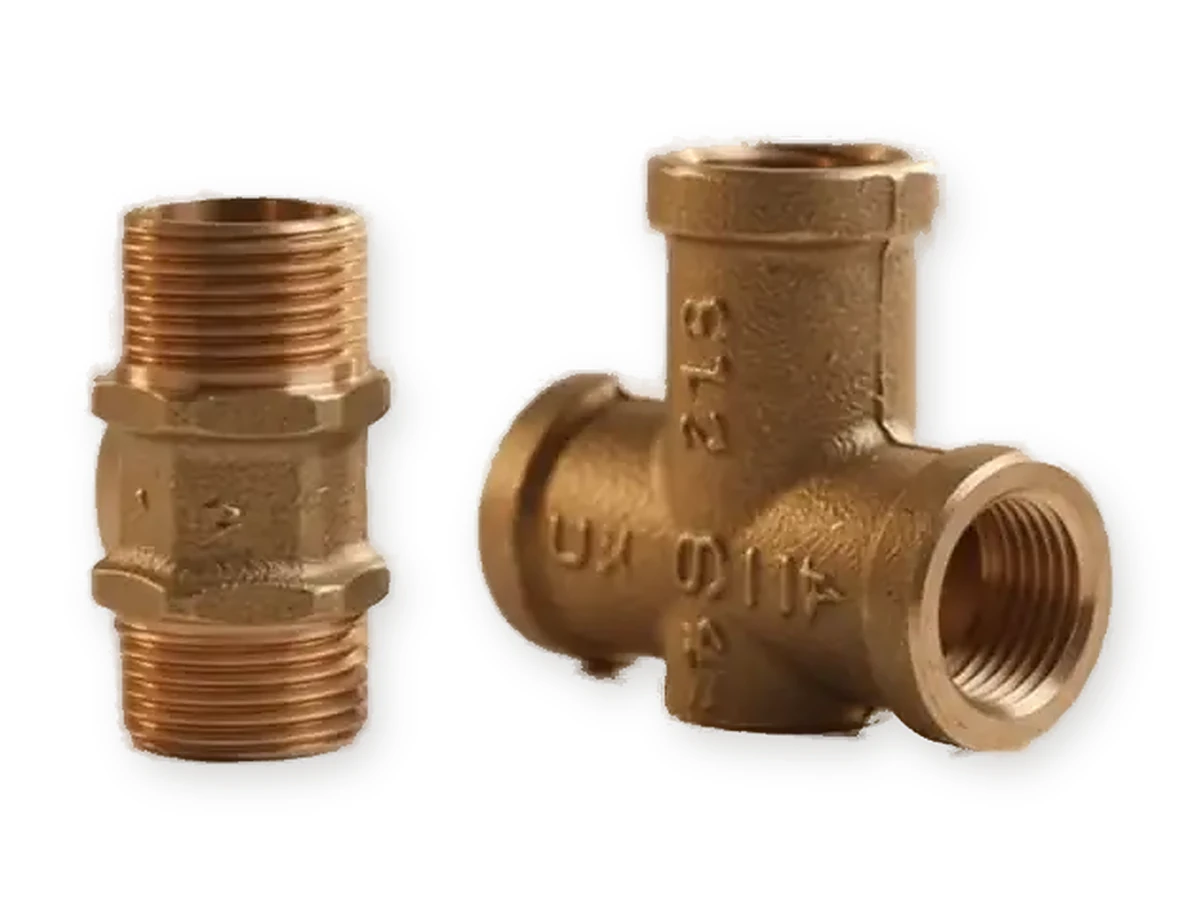
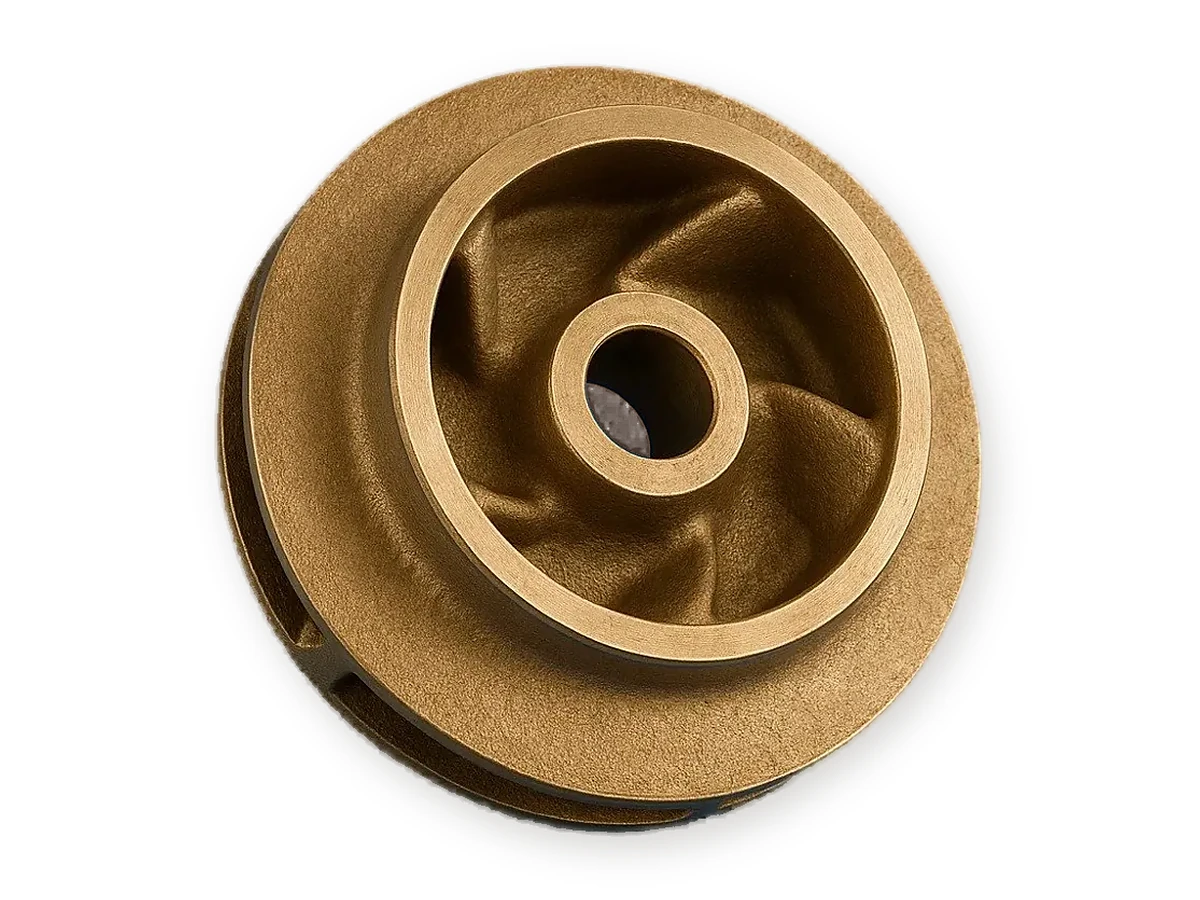
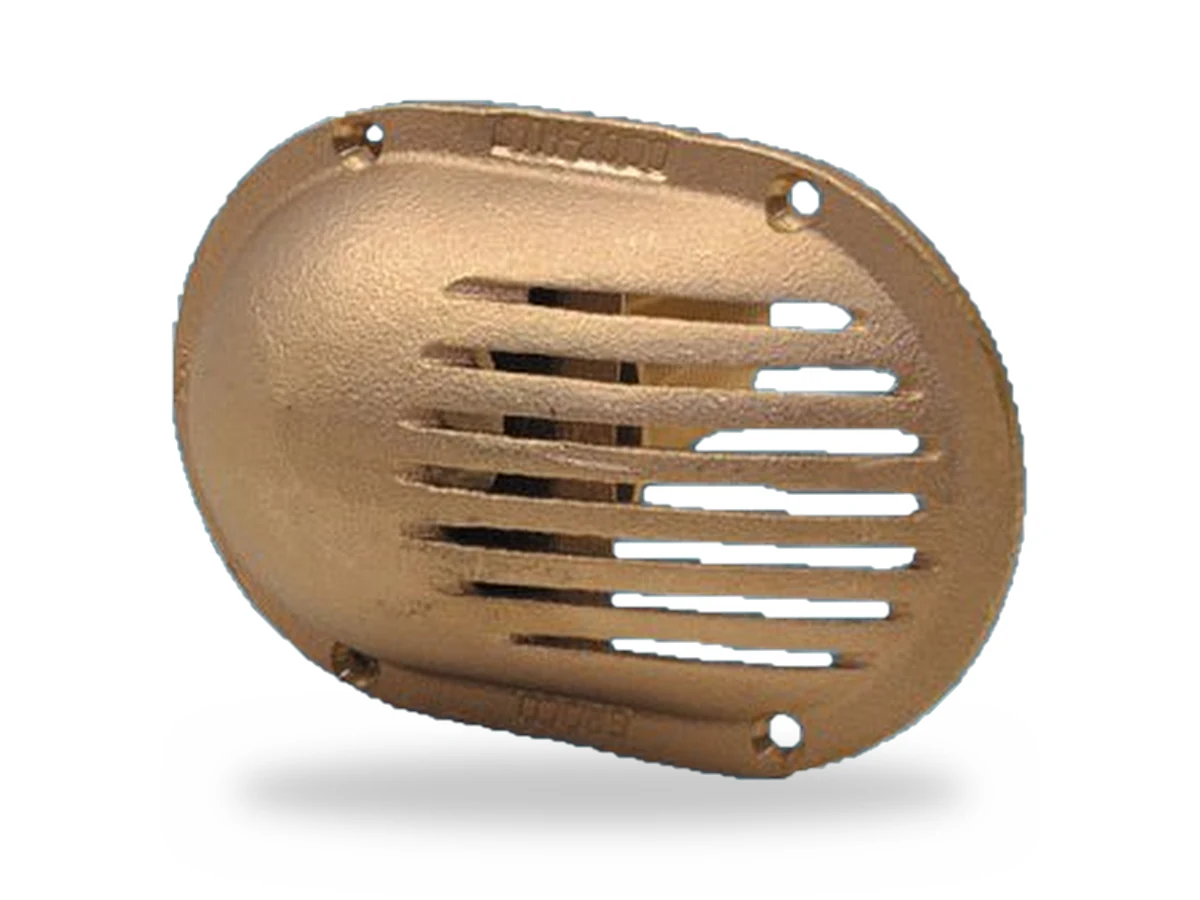
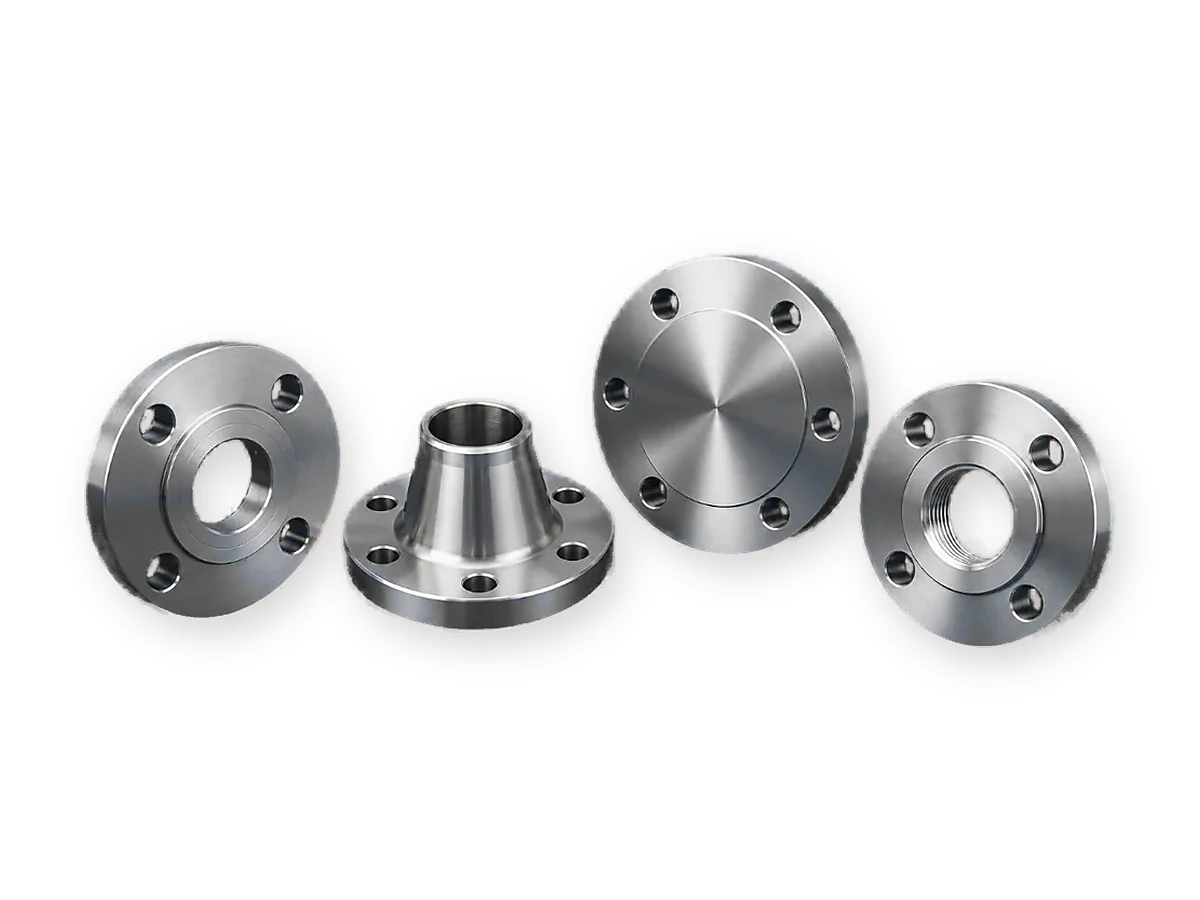
Our sand-cast components go into pumps and valves, marine and shipbuilding, water and chemical plants, plumbing and fire protection, sugar, cement and steel plants and power transmission. Typical parts include valve bodies and bonnets, pump casings and impellers, flanges and pipe fittings, sea-water strainers, heavy bushes and bearing housings, gear blanks and earthing hardware.
Cost and lead time
The price of a sand casting depends mainly on:
- Alloy and weight — metal is the largest share of the cost; copper-alloy prices follow the LME copper and tin market.
- Complexity — the number of cores and how much fettling the part needs.
- Machining — how many faces, bores and threads are machined and to what tolerance.
- Quantity — pattern cost is shared across the batch.
- Testing and documents — pressure testing, radiography or third-party inspection.
For a new part, pattern development and first samples typically take 2–4 weeks from drawing approval; repeat production batches follow the agreed delivery schedule. Use the engineering tools to estimate casting weight from your dimensions.
Sand casting — quick answers
Is sand casting strong enough for pressure parts?
Yes. With correct method design, gunmetal (C83600), tin bronze and aluminum bronze sand castings are used every day for valves, pumps and fittings at high pressure. We hydro-test bodies to the pressure on your drawing.
Can you sand cast to my existing pattern?
Yes. Customers often send their own patterns; we check them for shrinkage allowance and condition, repair them if needed, and cast to them.
What is the difference between sand casting and green sand casting?
Green sand is one type of sand casting, using clay-bonded moist sand. "Sand casting" also includes no-bake resin sand and CO₂ sand, which we choose for larger or more demanding parts.
Do you supply lead-free sand castings?
Yes — silicon bronzes and silicon brasses (for example C87600 and C87850) and bismuth bronzes are available for drinking-water and food applications.
How to get a quotation
To quote a sand casting we need: the drawing (2D PDF and, if available, 3D STEP/IGES), the alloy or standard, the annual quantity and batch size, machining and finish requirements, and any testing or documents you need. A sample works too. Send it through our quotation form or on WhatsApp — our engineers reply with the recommended route, alloy and a clear quotation.
Alloys we cast by sand casting
● dedicated pages first.
Other processes
Industries served
Product families made by sand casting
Questions buyers ask
What size of parts can be sand cast?+
Sand casting suits everything from small fittings to heavy pump casings; share the part weight and size and we confirm the molding route.
Is sand casting good for small quantities?+
Yes — pattern cost is low, so it is the most economical route for prototypes and small or medium batches.
What finish does sand casting give?+
A slightly textured as-cast surface; faces that need accuracy are machined. Shell molding gives a smoother finish where needed.
Send your drawing, get a quotation.
DWG, PDF, STEP or a sample photo — with quantity and destination port.