
21 alloys
Continuous Casting
Continuous drawing of solid and hollow bar for machining stock with uniform structure along the length.
Continuous Casting — complete guide
Continuous casting produces bronze, brass and copper-alloy bar — solid, hollow and profiled — with the most uniform, dense structure of any casting process. Molten metal flows from a holding furnace through a water-cooled graphite die, solidifies as it passes through, and is drawn out as a continuous length that is cut to size. Because every millimeter of the bar is cast under the same conditions, properties are consistent from end to end and there is practically no porosity. At Conex Casting Foundry, continuously cast bar is the machining stock for bushes, bearings, nuts, valve parts and precision components.
This guide explains how continuous casting works, the shapes and sizes available, the alloys used, the quality advantages over sand and centrifugal casting, and how to specify bar stock or finished parts machined from it.
What is continuous casting?
In continuous casting of copper alloys, a graphite die is attached to the bottom or side of a furnace holding molten metal. The die is surrounded by a water-cooled jacket. Metal enters the die, starts to solidify against the cold die wall, and is drawn out by withdrawal rolls in a controlled stop-start rhythm. By the time it leaves the die, the bar has a solid shell; it continues to cool and is cut to length by a saw.
The process can run horizontally or vertically. Horizontal casters are common for solid and hollow bronze bar; vertical casters are used for larger diameters and some tube sizes. Hollow bar is produced by placing a graphite mandrel in the center of the die, so the bore is cast in and machining is reduced.
In the USA, continuously cast copper-alloy bar is specified to ASTM B505 (Copper Alloy Continuous Castings) — the standard most bushing and bearing manufacturers use. EN 1982 designates continuous castings with the suffix -GC (for example CuSn7Zn4Pb7-C-GC).
How continuous casting works
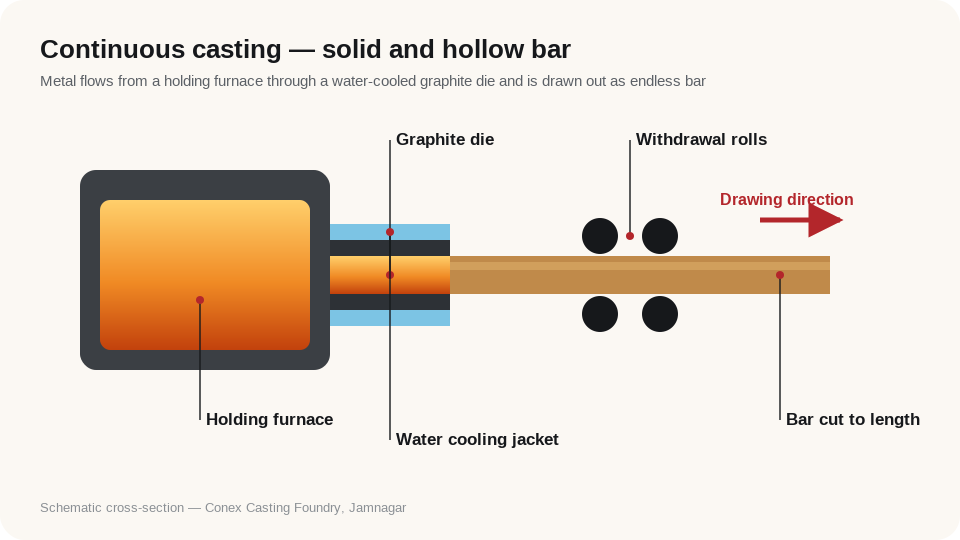
- Melting and holding. Metal melted to the specified grade is transferred to a holding furnace, which keeps it at a steady temperature and composition.
- Die and cooler. A graphite die with the bar profile — round, hollow, square, hexagonal or custom — sits in a water-cooled copper jacket.
- Starting. A starter bar is inserted into the die; metal freezes onto it, and withdrawal begins.
- Withdrawal cycle. Rolls pull the bar out in a programmed rhythm of short pulls and pauses. The cycle controls shell thickness, surface quality and internal soundness.
- Secondary cooling. The bar continues to cool by water spray or air as it moves away from the die.
- Cutting. A flying or stationary saw cuts the bar to length, commonly in standard lengths or to your order.
- Inspection. Bars are checked for chemistry, dimensions and straightness; test pieces are taken for mechanical properties.
- Machining. Bars are supplied as stock, or machined at our facility into finished bushes, bearings and parts.
How the withdrawal cycle shapes the bar
A continuous caster does not pull the bar out at a steady speed. It uses a repeating cycle — a short pull, a pause, sometimes a small push back — that may repeat many times a minute. During each pause, a new layer of metal solidifies against the cooled die wall and bonds to the shell already formed; during each pull, the bar moves out and fresh liquid metal flows in behind it. The length of the pull, the dwell time and the overall speed are set for each alloy and size.
Getting the cycle right decides three things. It decides the surface: too long a pull leaves visible cold laps; a well-tuned cycle gives a smooth skin with only faint ripple marks. It decides the internal soundness: the solidification front must move at a rate that lets liquid metal feed the center of the bar. And it decides productivity: a faster cycle produces more bar per hour, but only up to the point where quality suffers. Our operators tune and record the cycle for every alloy and size we cast.
Shapes and sizes
| Form | Description | Typical uses |
|---|---|---|
| Solid round bar | Diameters from small to large; standard and custom lengths | Machined bushes, nuts, pins, valve stems |
| Hollow bar (tube) | Cast with a central bore to minimize machining | Bushes, bearings, sleeves |
| Square, rectangular, hex | Constant profiles from shaped dies | Wear plates, gibs, nuts, fittings |
| Custom profiles | Special cross-sections from dedicated dies | Repeat parts with a constant section |
Hollow bar is usually the most economical stock for bushes: the bore is cast close to size, so less metal is bought and less is machined away compared with solid bar.
Alloys we continuously cast
| Alloy family | Typical grades (ASTM B505 / EN 1982) | Typical parts |
|---|---|---|
| Leaded tin bronze (bearing bronze) | C93200 (SAE 660), C93500, C93700, C93800, CC493K | General-purpose bushes and bearings |
| Tin / phosphor bronze | C90500, C90700, C91700, CC480K, CC483K | Gears, worm wheels, high-load bushes |
| Gunmetal | C83600, LG2 | Valve parts, fittings, bushes |
| Aluminum bronze | C95400, C95500, C95900 | Heavy-duty wear parts, valve seats, gears |
| Manganese bronze | C86300 | Slow-speed high-load bearings, screw-down nuts |
Our alloy library lists composition, properties and equivalents for each grade.
Why continuously cast bar is the preferred bearing stock
- Uniform structure — every section of the bar solidifies under the same conditions, so properties are consistent along the full length.
- Fine grain and density — fast, directional solidification in the cooled die gives a fine, dense structure with practically no porosity.
- Even lead distribution — in leaded bearing bronzes, rapid solidification keeps the lead finely dispersed, which is what gives the bearing its anti-seizure properties.
- Close tolerances — bars are cast close to size, so machining allowances are small.
- Clean surface — the graphite die gives a smooth, clean skin.
- No tooling per part — standard dies serve many customers' parts, so even small quantities of finished bushes are economical.
Continuous versus centrifugal and sand casting
| Continuous | Centrifugal | Sand | |
|---|---|---|---|
| Structure | Fine, uniform along length | Fine, densest at OD | Coarser, varies with section |
| Porosity | Practically none | Practically none | Depends on method |
| Best size range | Small to medium diameters, any length | Medium to large diameters | Any size, complex shapes |
| Shapes | Constant cross-section | Round | Almost any |
| Tooling | Standard graphite dies | Molds by diameter | Pattern per part |
| Typical use | Bush and bearing stock, machined parts | Large bushes, rims, sleeves | Bodies, housings, complex parts |
Designing and specifying parts from continuous cast bar
- Specify the alloy by standard — for example ASTM B505 C93200 or EN 1982 CC493K-GC.
- Give finished dimensions — we select the nearest solid or hollow bar size to minimize machining.
- Describe the bearing duty — load, speed, lubrication and shaft material — so we can confirm the grade.
- Specify features — oil grooves, holes, flanges, chamfers, graphite plugs — which we machine on CNC.
- Testing and documents — chemical analysis, hardness, tensile test results and mill certificates are available with each lot.
Bearing design basics
Most continuous cast bar becomes plain bearings and bushes. A few design points make the difference between a bush that lasts for years and one that wears out quickly:
- Running clearance. The bore must allow an oil film to form. A typical starting point for oil-lubricated bushes is a diametral clearance of roughly 0.1–0.2% of the shaft diameter, adjusted for speed, temperature and the bush closing in when pressed into its housing.
- Press fit. The outside diameter is usually an interference fit in the housing so the bush cannot rotate; the amount depends on housing material and wall thickness.
- Load and speed. Bearing alloys are rated by the pressure they carry (P), the rubbing speed (V) and the product of the two (PV). Leaded tin bronzes suit moderate PV; tin and aluminum bronzes carry higher loads at lower speeds.
- Lubrication. Oil grooves and holes must bring lubricant into the loaded zone, not away from it. For hard-to-reach bushes, graphite plugs or grease grooves extend service intervals.
- Shaft material. Harder bronzes need hardened, ground shafts; softer leaded bronzes tolerate softer shafts and some misalignment.
Our engineers check these points when reviewing a drawing and suggest changes where they will extend bearing life.
Worked example: SAE 660 bushes for a conveyor maker
A material-handling customer needs 6,000 flanged bushes a year in three sizes, oil-lubricated, running on mild-steel shafts.
- Alloy: C93200 (SAE 660) leaded tin bronze, to ASTM B505 — conformable and tolerant of the softer shaft.
- Stock: hollow continuous cast bar chosen for each size, so the bore needs only finish machining — reducing metal purchase by more than a third compared with solid bar.
- Machining: bushes turned on CNC lathes with flange, chamfers, oil hole and a single helical groove; outside diameter held to the press-fit tolerance.
- Quality: each bar lot checked for chemistry and hardness; first-article dimensional report; certificates with every shipment.
Ordering checklist
For bar stock, tell us the alloy and standard, the outside diameter and — for hollow bar — the bore, the length per bar, the quantity in kilograms or pieces, and any certification needed. For finished parts, send the drawing with fits, grooves and chamfers marked, the annual quantity, and the bearing duty. We will choose solid or hollow bar to give the best yield and quote the finished part.
Quality control
Under our ISO 9001:2015 system, continuous casting is controlled through melt chemistry (spectrometer checks), holding temperature, cooling water flow and temperature, and the withdrawal cycle. Bars are inspected for surface quality, dimensions and straightness; test pieces are taken for tensile strength and hardness as required by ASTM B505. Each lot is traceable to its heat, and material test certificates are supplied with every consignment.
| Defect | Cause | Prevention |
|---|---|---|
| Surface cold laps, ripple marks | Unsuitable withdrawal cycle, low temperature | Cycle and temperature tuning |
| Centerline porosity | Insufficient feeding at the core of large bars | Cooling and withdrawal control |
| Breakouts | Thin shell leaving the die | Cooling and speed control, die maintenance |
| Lead segregation | Slow solidification | Correct cooling intensity |
Typical parts from continuous cast bar
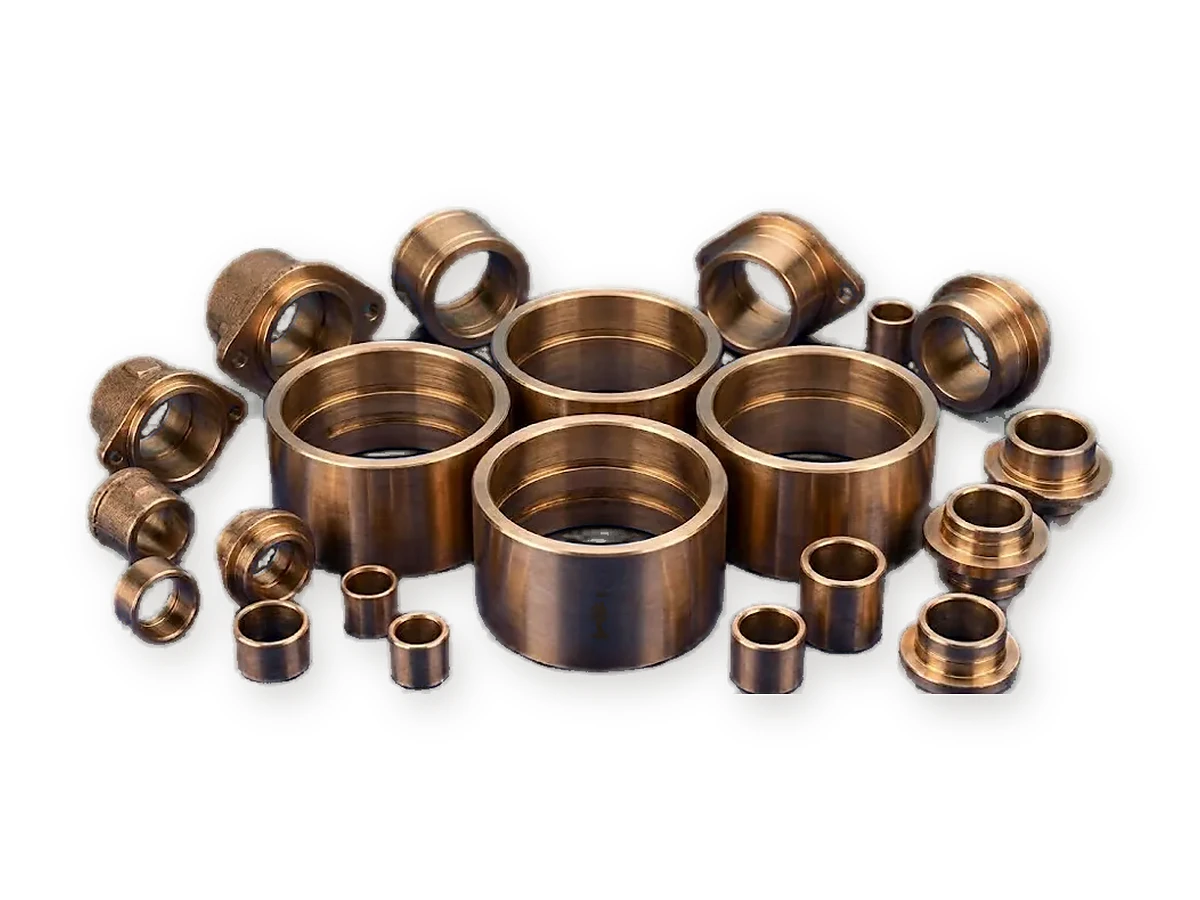
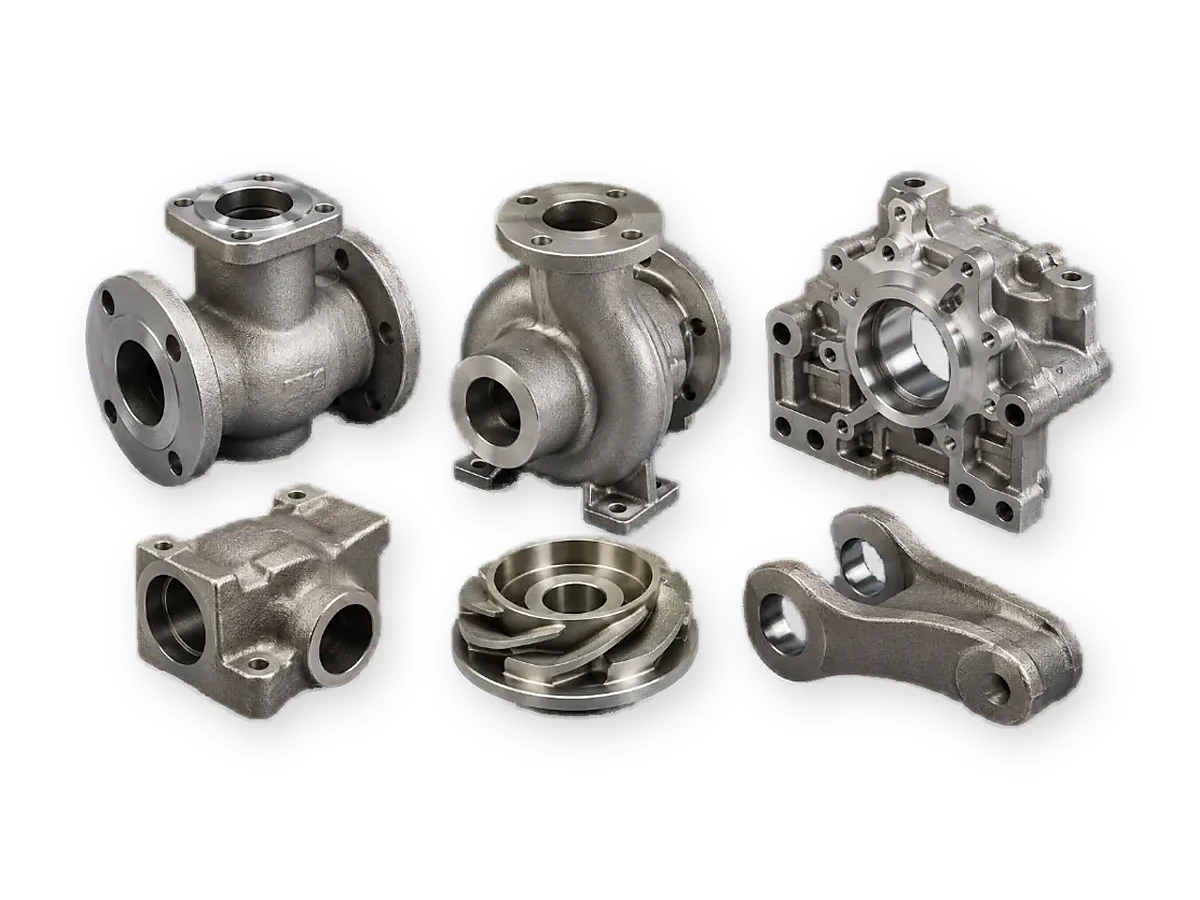
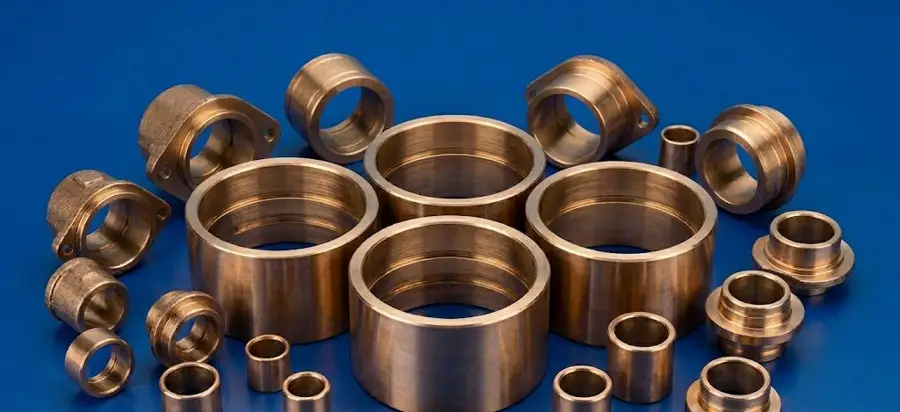
Typical parts include plain and flanged bushes, bearings and wear plates, lead-screw nuts, valve stems and seats, gears and worm wheels, and precision turned parts — for machine tools and general engineering, earthmoving, heavy machinery, material handling, pumps and valves and agricultural machinery.
Choosing between bronze grades for bar stock
Because continuous cast bar is used mostly for bearings, buyers often ask which grade to choose. In broad terms, C93200 (SAE 660) is the default for general-purpose bushes: it is easy to machine, conforms to small misalignments and tolerates occasional lubrication problems. C93700 and C93800, with more lead, are chosen where lubrication is poor or the shaft is soft. C90500 and C90700 tin and phosphor bronzes offer higher strength and wear resistance for gears and heavily loaded slides. C95400 aluminum bronze carries the highest loads and shocks and resists corrosion, but needs a hardened shaft and good lubrication. C86300 manganese bronze is used for very heavy, slow-moving loads such as screw-down nuts in rolling mills. For drinking-water and food equipment, lead-free bronzes are available.
The alloy selector lets you compare grades by cost, machinability and conductivity, and each grade page in the alloy library lists equivalents in EN, BS, DIN, JIS and other standards.
Where continuous casting fits at Conex
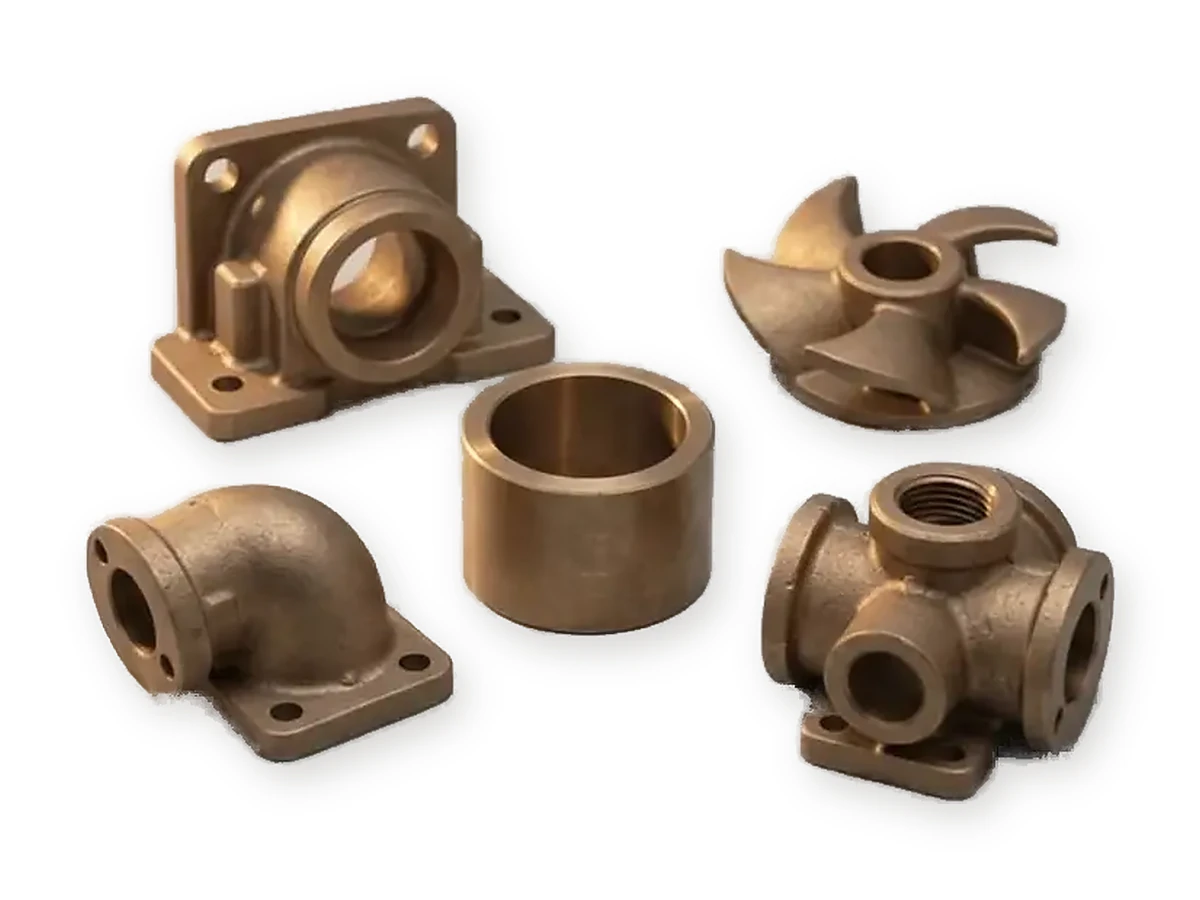
Continuous casting complements our other routes. Small and medium bushes and precision turned parts come from continuous cast bar; larger bushes, rims and sleeves are cast centrifugally close to size; complex bodies and housings are sand or die cast. Because we offer all of these, with in-house CNC machining, we can supply a complete set of bronze components for an assembly — bushes, wear plates, nuts, gears and housings — with consistent alloy certification and one point of contact.
Continuous casting is also the most economical route for repeat orders of small quantities: since standard dies are shared, a customer who needs only a few dozen bushes of a size pays no tooling cost at all.
Continuous cast stock at Conex
We hold the popular bearing-bronze grades in common solid and hollow sizes, so repeat orders of bushes and turned parts can be machined without waiting for new castings. Every bar is traceable to its heat and supplied with a certificate, and our CNC section turns bar into finished bushes, nuts, wear plates and valve parts to your drawing.
Cost and lead time
Because standard dies are used, there is no part-specific tooling cost for round, hollow and common profile bars. Cost is driven by alloy, weight and machining. Common sizes in popular bearing bronzes can be supplied quickly; machined parts follow after CNC programming and first-article approval.
Continuous casting — quick answers
Is continuous cast bronze the same as extruded bronze?
No. Extruded bar is hot-worked from a cast billet; continuous cast bar is cast directly to shape. Leaded bearing bronzes cannot be extruded, so for SAE 660 / C93200 continuous casting is the standard route.
What is the most common continuous cast bearing bronze?
C93200 (SAE 660, bearing bronze), followed by C95400 aluminum bronze for heavier duty and C90700 phosphor bronze for gears and high loads.
Can you supply bar stock only?
Yes — cut lengths of solid or hollow bar, or finished machined parts.
What lengths are available?
Bars are cast continuously and cut to length — standard stock lengths, or lengths cut to suit your machining.
Can continuous cast bar be used for valve parts?
Yes. Gunmetal and aluminum-bronze bars are machined into valve stems, seats and discs, where uniform, dense metal is valuable for sealing surfaces.
Why does my bush wear quickly?
Usually because of a mismatch between alloy, clearance, lubrication and shaft hardness. Send us the details of the application and the worn part — we will review and recommend a better grade or design.
Request a quotation
Send the finished part drawing or bar sizes, alloy, quantity and testing requirements through our quotation form or WhatsApp. We will recommend solid, hollow or centrifugal stock for the best yield and quote clearly.
Alloys we cast by continuous casting
● dedicated pages first.
Other processes
Industries served
Product families made by continuous casting
Questions buyers ask
Which standard covers continuous cast bronze bar?+
ASTM B505 in the USA; EN 1982 with the -GC suffix in Europe.
What does continuous casting produce?+
Solid and hollow bar and profiles with a uniform structure along the length — ideal machining stock for bushes.
Can you supply cut lengths?+
Yes — bar can be supplied in cut lengths or machined into finished parts.
Send your drawing, get a quotation.
DWG, PDF, STEP or a sample photo — with quantity and destination port.