
9 alloys
Gravity Die Casting
Molten metal poured into reusable metal molds (permanent mold) — dense, repeatable castings for medium and high volumes.
Gravity Die Casting — complete guide
Gravity die casting produces dense, accurate, repeatable castings by pouring molten metal into a reusable metal mold. Because the die is made of steel or cast iron rather than sand, the metal cools faster and forms a fine-grained, strong structure, and every casting comes out the same shape as the last. At Conex Casting Foundry we gravity die cast brass, aluminum bronze, silicon bronze and aluminum parts — electrical hardware, plumbing fittings, cable-gland bodies, line clamps and connectors — in medium and high volumes, then machine and inspect them in-house.
This guide covers how gravity die casting works, the dies and coatings involved, which alloys and parts suit it, the accuracy and finish you can expect, design rules, quality control, and how it compares with sand, permanent mold and pressure die casting.
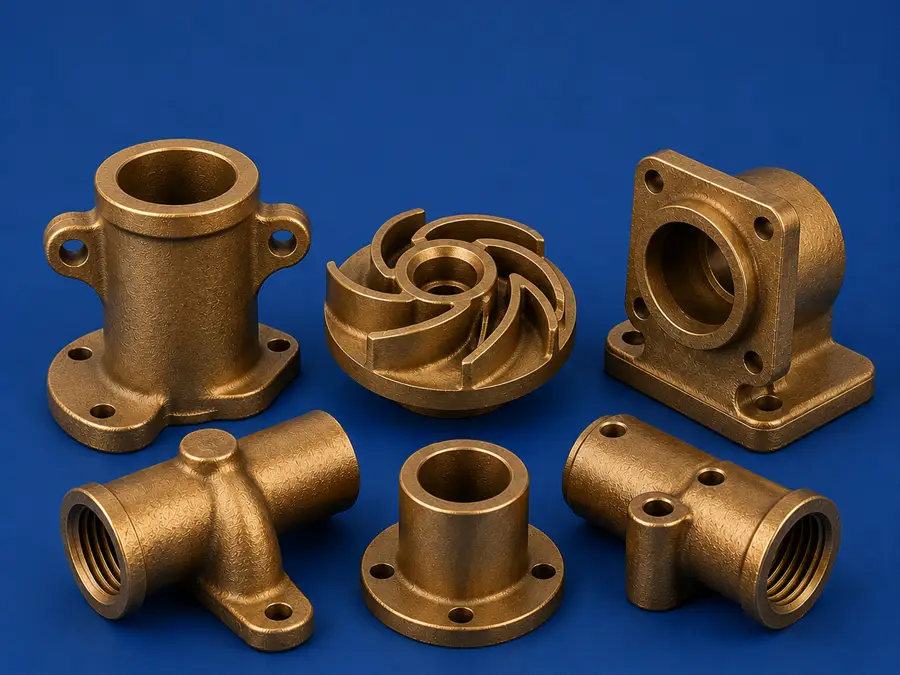
What is gravity die casting?
In gravity die casting, molten metal is poured from a ladle into a metal mold — the die — and fills the cavity under its own weight. No pressure is applied, which distinguishes it from low-pressure and high-pressure die casting. The die is made in two or more parts that open to release the casting, and it is reused for thousands of castings.
The process is known by several names. In Europe it is usually called gravity die casting; in the USA the same process is called permanent mold casting (see our permanent mold page for the variant with sand cores and tilt pouring). Standards reflect this: copper-alloy permanent mold castings are covered by ASTM B806, and EN 1982 designates them with the suffix -GM (for example CC754S-GM for die-casting brass).
How gravity die casting works
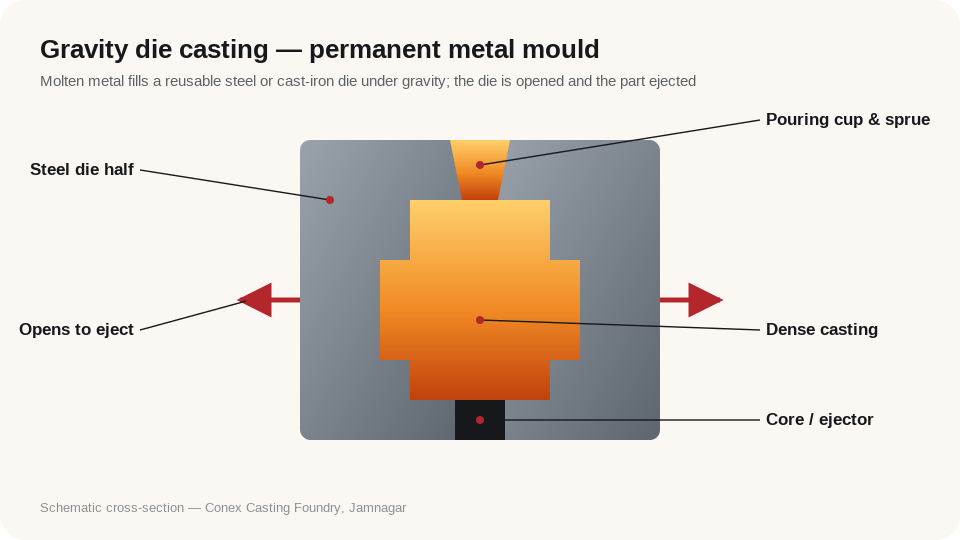
- Die design and manufacture. The die cavity, gating, vents and ejection are designed from your drawing and machined from cast iron or hot-work tool steel (such as H13). Metal or sand cores form internal shapes.
- Pre-heating. The die is heated to its working temperature before production — cold dies cause cold shuts and cracks.
- Coating. A thin refractory coating (die dressing) is sprayed onto the cavity. It controls heat transfer, helps the metal flow and protects the die from the molten metal.
- Closing and core setting. Cores are placed and the die halves are clamped together, manually or on a die-casting machine.
- Pouring. Metal melted and checked to your grade is poured into the pouring cup at a controlled rate and temperature. On tilting machines the die rotates from horizontal to vertical as it fills, for calm, non-turbulent filling.
- Solidification. The metal freezes quickly against the die wall, forming a fine-grained, dense skin.
- Opening and ejection. The die opens, the casting is removed or ejected, and the die is re-coated as needed for the next cycle.
- Finishing. Gates and risers are trimmed, flash is removed, and the castings are machined and inspected.
Dies, coatings and die life
The die is the major investment in gravity die casting, and its design decides both quality and cost per part. Key points:
- Die material. Grey or ductile cast iron is economical for simpler shapes and moderate volumes; hot-work tool steel gives better life and detail for complex or long-running parts.
- Die temperature. Each alloy has a working window. Copper alloys are poured much hotter than aluminum, so dies for brass and bronze run hotter and experience more thermal fatigue.
- Coatings. Insulating coatings on thin sections slow cooling and help filling; conductive coatings on heavy sections speed cooling and reduce shrinkage — a tool our engineers use to control solidification.
- Die life. Dies for aluminum alloys can last for very long runs; dies for brass and bronze typically make thousands to tens of thousands of castings before refurbishment, depending on alloy, size and complexity. We maintain and repair dies in our own tooling department.
- Cores. Simple internal shapes use withdrawable metal cores; complex passages use sand or shell cores, making the process semi-permanent.
Static and tilt pouring
There are two ways to fill a gravity die, and the choice affects quality as much as the die itself.
In static pouring, the die stands still — usually vertical — and metal is poured into a pouring cup at the top. It is simple and quick, and suits small parts with short flow paths. The drawback is that metal falls through the sprue, and a falling stream of molten copper alloy can entrain air and oxide films.
In tilt pouring, the die starts horizontal with a pouring basin attached. Metal is poured into the basin, then the die is rotated slowly to vertical, so the metal flows into the cavity along the die wall rather than falling. Filling is calm and progressive, the oxide skin on the metal stays intact, and the casting comes out cleaner and denser. Tilt pouring is particularly valuable for aluminum bronze and aluminum alloys, which form tough oxide films that would otherwise be folded into the casting. For pressure-tight and safety-critical parts, we usually recommend tilt pouring.
Copper alloys versus aluminum in metal dies
Gravity die casting is best known for aluminum, which melts at around 660 °C and is gentle on dies. Copper alloys are poured at 950–1,200 °C, which is far harder on the die steel: every cycle heats the cavity surface sharply and then lets it cool, and over thousands of cycles this thermal cycling causes fine cracks ("heat checking"). Successful brass and bronze die casting therefore depends on:
- dies designed with the right wall thickness and cooling to keep temperature swings small;
- alloys with good die-casting behavior — die-casting brasses, silicon brasses and aluminum bronzes;
- disciplined coating practice that insulates the cavity and protects the steel;
- planned die maintenance, so cracks are polished out and inserts replaced before they mark the castings.
This is specialist know-how, and it is one of the reasons buyers come to an experienced non-ferrous foundry rather than a general aluminum die caster for brass and bronze parts.
Alloys we gravity die cast
| Alloy family | Typical grades | Typical parts |
|---|---|---|
| Die-casting brass | C85700, C85800, CC754S (CuZn39Pb1Al), CW617N cast equivalents | Plumbing fittings, cable-gland bodies, valve parts, hardware |
| DZR brass | CC770S, CuZn35Pb2Al-C type | Potable-water fittings resistant to dezincification |
| Silicon bronze & silicon brass | C87500, C87600, C87850 | Electrical line hardware, connectors, lead-free fittings |
| Aluminum bronze | C95200, C95400, CC331G | Wear parts, valve trim, marine fittings |
| Aluminum alloys | LM6, LM25 (A356), AlSi7Mg | Housings, brackets, electrical enclosures |
Leaded tin bronzes and very high-lead bearing alloys are usually better made by sand, centrifugal or continuous casting. Full grade data is in our alloy library.
Accuracy, finish and design limits
| Characteristic | Typical gravity-die value |
|---|---|
| Dimensional tolerance (ISO 8062-3) | DCTG 7–9 |
| Example: a 100 mm dimension | about ±0.4 to ±0.7 mm as cast |
| Surface roughness | Ra 3.2–6.3 µm |
| Minimum wall | about 3–4 mm |
| Draft | 1–3° external, 2–5° internal |
| Machining allowance | about 1–1.5 mm per face |
| Typical weight | about 50 g to 15 kg |
The real advantage is consistency: because the die does not change, dimensions repeat closely from part to part, which makes automated machining and assembly reliable.
Mechanical properties: why gravity die castings are stronger
Metal in contact with a metal die cools much faster than metal in sand. Faster cooling produces a finer grain structure, and finer grain gives higher strength, better ductility and a denser surface. In practice, gravity die cast brass and aluminum bronze parts typically show higher tensile strength and elongation than the same alloy sand cast, along with better pressure tightness in thin sections. That is why electrical clamps, connectors and plumbing fittings that must not crack when tightened are so often gravity die cast.
Designing parts for gravity die casting
- Uniform walls of 3–6 mm are ideal; avoid sudden changes, which cause hot spots and sink marks.
- Draft on all walls parallel to the die opening; internal features need more draft than external ones because the metal shrinks onto them.
- Generous radii at internal corners improve metal flow and die life.
- Undercuts need sand cores or movable die sections; minimizing them keeps the die simpler and cheaper.
- Holes under about 6–8 mm diameter are usually drilled rather than cast.
- Parting line position — tell us which faces are cosmetic or sealing faces, so the parting line and ejector marks stay off them.
Gravity die casting compared with other processes
| Sand casting | Gravity die | Low-pressure die | High-pressure die | |
|---|---|---|---|---|
| Mold | Sand, new each time | Metal, reusable | Metal, reusable | Hardened steel, reusable |
| Tooling cost | Low | Medium–high | High | Highest |
| Best quantity | 1 – thousands | Thousands – hundreds of thousands | Thousands upward | Tens of thousands upward |
| Tolerance (ISO 8062) | DCTG 9–12 | DCTG 7–9 | DCTG 6–8 | DCTG 5–7 |
| Minimum wall | 3–5 mm | 3–4 mm | 2.5–3 mm | 1–2.5 mm |
| Internal soundness | Good with correct method | Very good | Excellent | Some entrapped porosity |
| Heat-treatable / weldable | Yes | Yes | Yes | Limited |
Sand or gravity die? Working out the break-even
The most common question we are asked about gravity die casting is when it becomes cheaper than sand casting. The answer depends on three numbers: the die cost, the saving per part, and the number of parts you will buy over the life of the die.
The saving per part comes from several places at once. There is no molding sand to prepare and no mold to ram for each casting. Metal yield is better, because gates and risers are smaller. Machining allowances are smaller, so less metal is bought and less is machined away. Fettling is quicker, because there is less flash and no burnt-on sand. And because every casting is the same, machining fixtures and programs run without adjustment, which reduces machining time and scrap.
Divide the die cost by the saving per part and you have the break-even quantity. For a small brass fitting the break-even may be reached within a single year's order; for a large, low-volume casting, sand may stay cheaper for the life of the product. When we quote, we show both routes where they are close, with the die cost and the part prices side by side, so the decision is yours and is based on real figures.
Quality control
Our quality system is certified to ISO 9001:2015. For gravity die castings we control:
- Die temperature — monitored throughout the shift, because it decides filling, surface and shrinkage.
- Coating condition — re-applied at set intervals to keep surface quality consistent.
- Melt chemistry — spectrometer check of every melt; zinc loss in brass is corrected.
- First-off and patrol inspection — dimensions checked at the start of each run and at intervals during it.
- Testing — pressure or leak testing for fluid parts, torque or proof-load testing for clamps where specified, and dezincification testing for DZR brass on request.
| Defect | Cause | Prevention |
|---|---|---|
| Cold shut / misrun | Die or metal too cold, slow pour | Die pre-heat, temperature control, insulating coating on thin areas |
| Shrinkage porosity | Heavy section not fed | Riser and gate design, conductive coatings, cooling channels |
| Hot tears | Restrained contraction around cores | Draft, radii, collapsible sand cores, timely ejection |
| Surface laps, flow lines | Turbulent or interrupted filling | Tilt pouring, gating design |
| Soldering / die erosion | Coating breakdown, die too hot | Coating maintenance, die cooling |
Typical gravity die cast parts
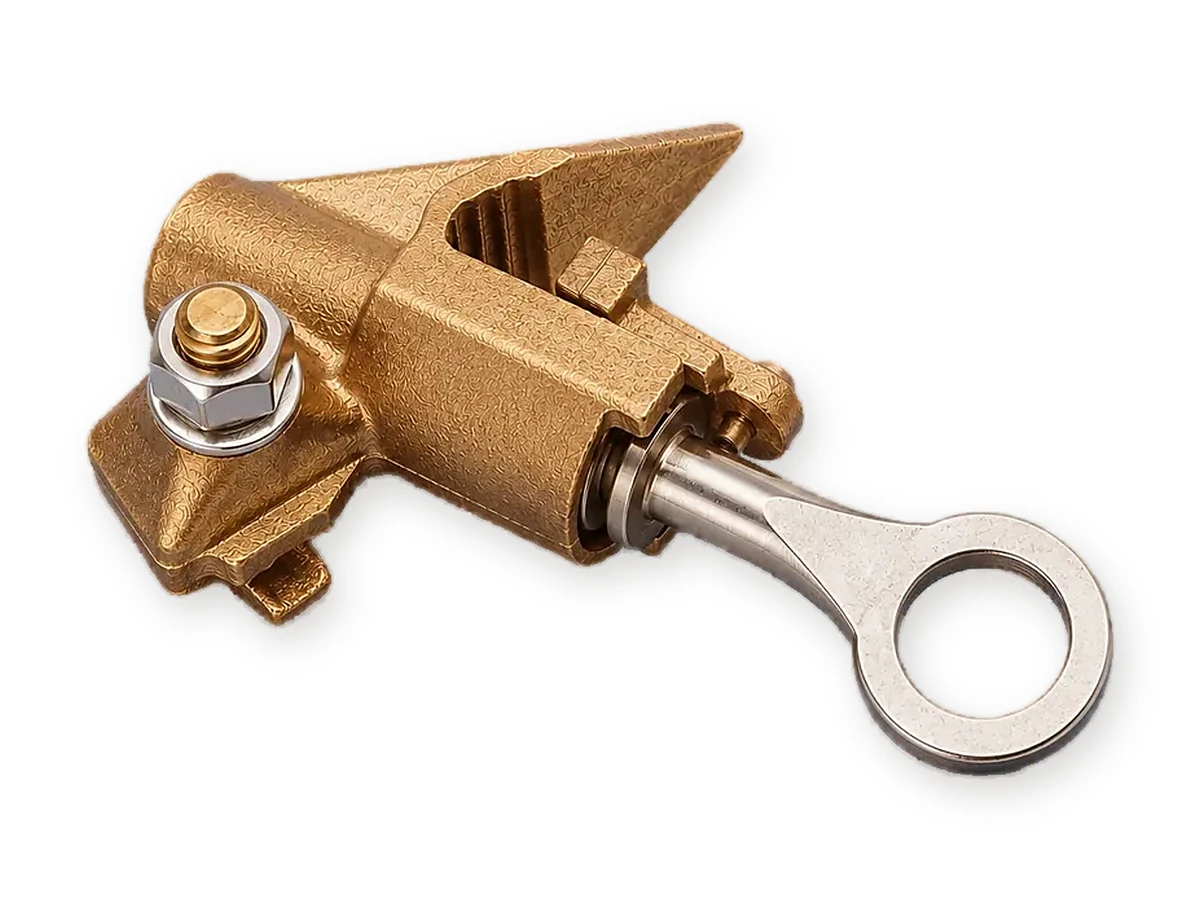
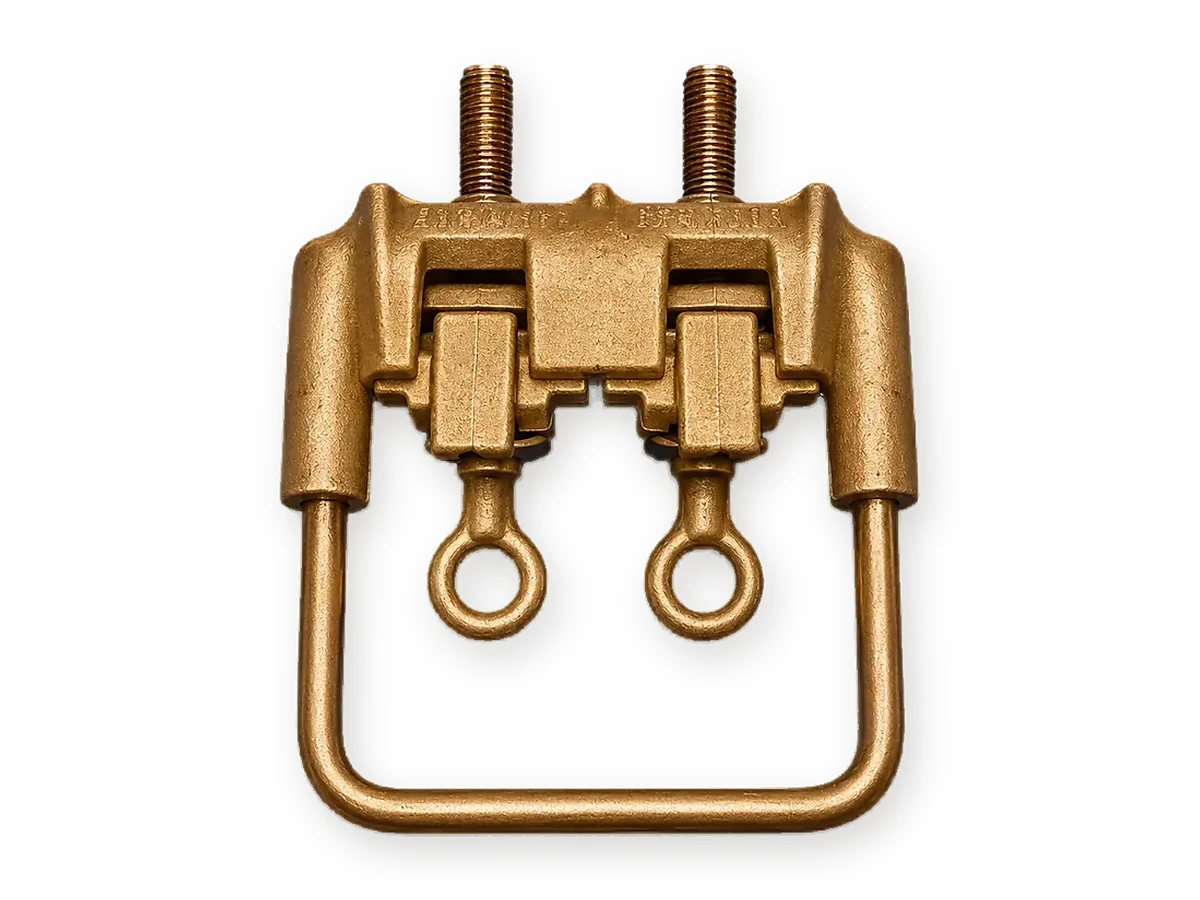
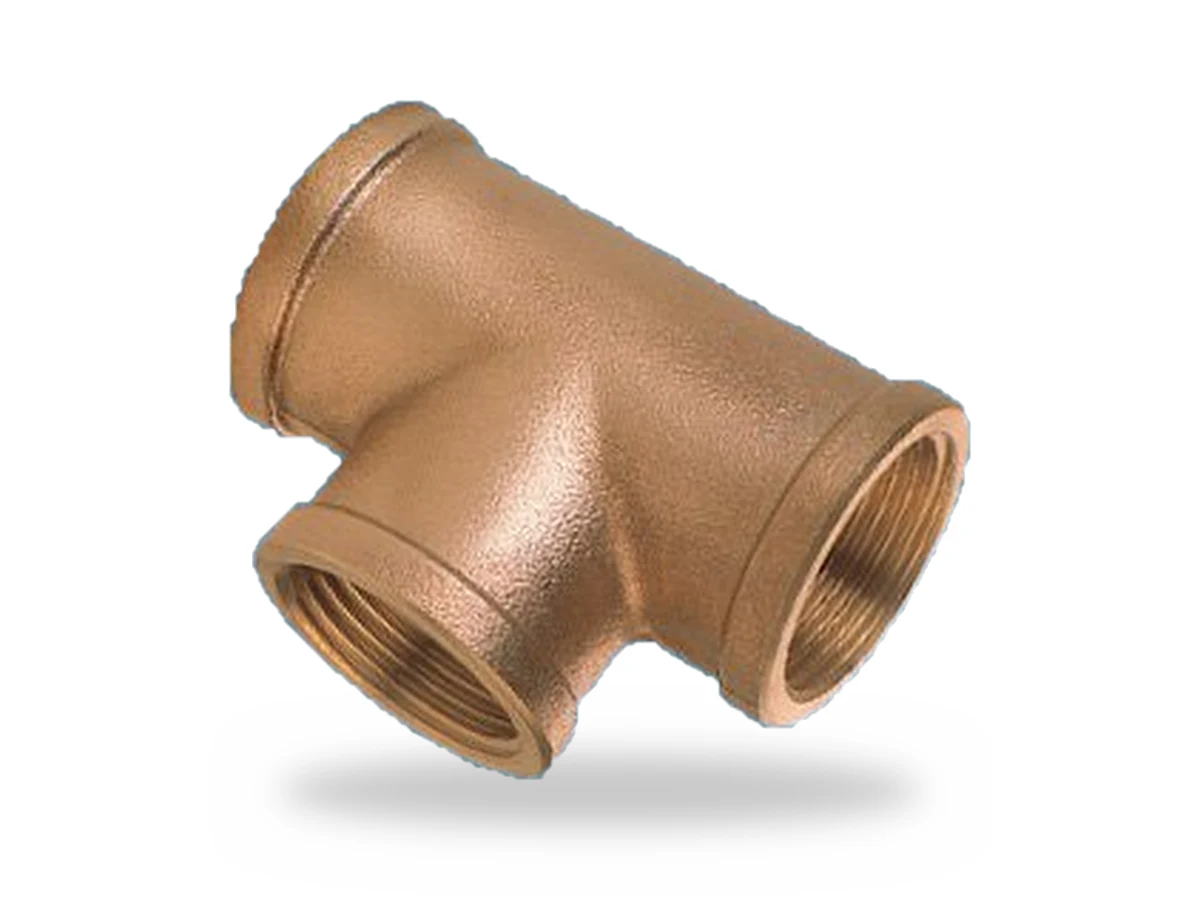
Power and electrical
Hotline, stirrup and PG clamps, connectors, terminals and cable-gland bodies for transmission and distribution, transformers and cable connectors.
Plumbing and water
Fittings, couplings, meter bodies and valve parts in brass and DZR brass for plumbing and fire protection and water systems.
Engineering
Aluminum housings and brackets, aluminum-bronze wear parts and general engineering components for machine tools and automotive applications.
Worked example: a silicon-bronze line clamp
A utility supplier needs 20,000 hotline clamp bodies a year in silicon bronze, with a threaded eye and a jaw that must not crack when the clamp is tightened onto a live conductor.
- Route: gravity die casting in a two-cavity cast-iron die, giving fine-grained, tough metal and identical jaw geometry on every piece.
- Design review: draft added to the jaw faces, the eye boss cored to keep the wall even, and the parting line moved off the conductor groove.
- Production: die temperature controlled through the shift; spectrometer check of every melt; first-off and hourly dimensional checks.
- Finishing: threads tapped and the eye machined on CNC; sample clamps proof-tested to the specified load.
- Documents: material certificate and inspection report with each consignment.
Machining and finishing after casting
Most gravity die castings are delivered machined. Because the castings are dimensionally consistent, they can be held in dedicated fixtures and machined on CNC lathes and machining centers with very little set-up between batches. Typical operations include facing, boring, threading (internal and external), drilling cross-holes and milling flats or slots. After machining, parts can be tumbled or vibro-finished to remove burrs, polished, or sent for nickel, tin or chrome plating. For potable-water brass parts, we can supply parts that are cleaned and leak-tested ready for assembly.
Because the die gives a consistent surface, cosmetic parts — handles, architectural hardware, visible fittings — can often be polished directly without machining the outer surface at all.
A brief history of the process
Pouring metal into permanent molds is one of the oldest casting methods: bronze-age smiths cast axes and spearheads in stone and bronze molds. The modern process, with machined iron and steel dies, refractory coatings and tilting machines, developed through the twentieth century alongside the automotive and plumbing industries, which needed large quantities of identical, sound castings. Today it is the standard route for brass plumbing fittings and electrical hardware worldwide, and it remains one of the most efficient ways to make strong, accurate copper-alloy parts in volume.
Cost and lead time
Gravity die casting has a higher tooling cost than sand casting, but a lower cost per part at volume because molding is eliminated, metal yield is better and machining allowances are smaller. As a rule of thumb, it becomes attractive once annual quantities reach a few thousand pieces of a part, or earlier where consistency and strength are critical. Die design and manufacture typically take 4–6 weeks after drawing approval, followed by samples for your approval. We quote die cost and part price separately so you can see the payback.
Gravity die casting — quick answers
What is the difference between gravity die casting and pressure die casting?
In gravity die casting, metal fills the die under its own weight; in pressure die casting it is injected at high speed and pressure. Gravity die castings are denser and can be heat treated or welded; pressure die castings can have thinner walls and finer detail.
Can you use my existing die?
Yes, after inspection. We check the die for wear, cracks and correct shrinkage allowance, and refurbish it if needed.
Is gravity die casting suitable for bronze bushes?
Plain bushes and sleeves are usually better made by centrifugal or continuous casting, which give the densest structure for bearings.
Can gravity die castings be heat treated?
Yes. Because they are dense and free from the entrapped gas typical of high-pressure die castings, gravity die castings in aluminum bronze and aluminum alloys can be heat treated to raise strength, and can be welded or brazed where needed.
What is the minimum order for a die-cast part?
There is no fixed minimum, but because the die is a one-time investment, the process is most economical from a few thousand pieces a year. For lower volumes we recommend sand or shell molding.
Request a quotation
Send your drawing, alloy, annual quantity and finish requirements through our quotation form or WhatsApp. We will tell you whether gravity die casting pays back for your volume, and quote die and part prices clearly.
Alloys we cast by gravity die casting
● dedicated pages first.
Other processes
Industries served
Product families made by gravity die casting
Questions buyers ask
What is gravity die casting?+
Molten metal is poured into a reusable metal mold (permanent mold) under gravity, giving dense, consistent castings.
Which alloys suit gravity die casting?+
Brasses, aluminum bronzes and aluminum alloys are commonly gravity die cast.
What quantities justify a die?+
Gravity dies cost more than sand patterns, so the route pays off as annual volumes grow; we compare both in the quotation.
Send your drawing, get a quotation.
DWG, PDF, STEP or a sample photo — with quantity and destination port.