
9 alloys
Permanent Mold Casting
Reusable metal molds filled by gravity or low pressure — dense, repeatable castings with a good surface and close tolerance for medium and high volumes.
Permanent Mold Casting — complete guide
Permanent mold casting makes dense, repeatable metal parts by filling a reusable metal mold — by gravity or under low pressure — instead of a sand mold that is destroyed after each casting. It sits between sand casting and pressure die casting: more accurate and stronger than sand, sounder and more versatile than high-pressure die casting, and economical from medium volumes upward. At Conex Casting Foundry we use permanent molds for electrical hardware, plumbing fittings, valve parts and meter bodies in brass, silicon bronze, aluminum bronze and aluminum alloys, machined and inspected in-house.
This page explains what permanent mold casting is, how it differs from gravity die casting, how semi-permanent molds with sand cores extend what it can do, and how to decide whether your part should be made this way.
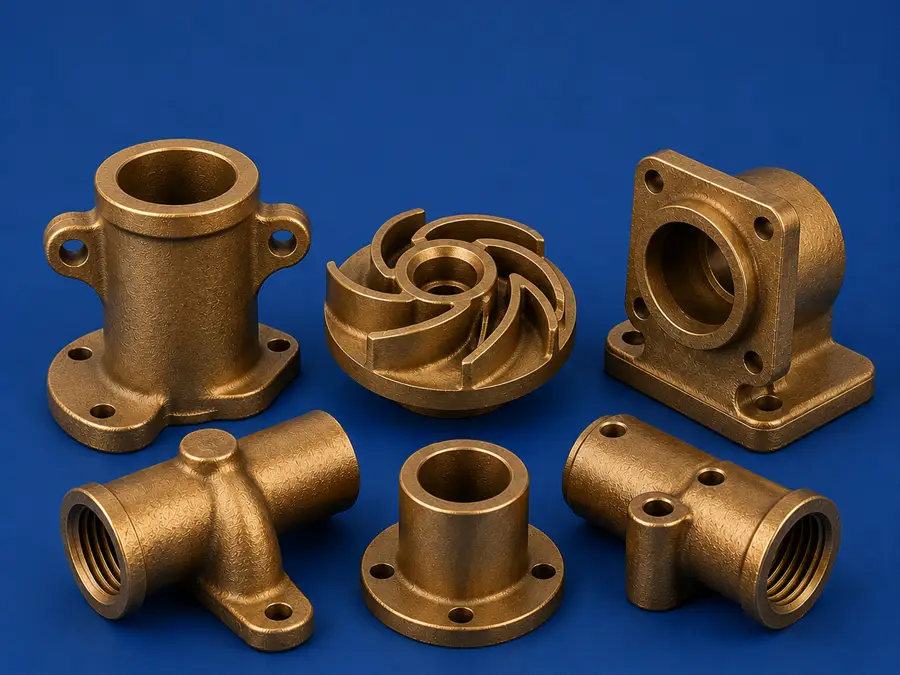
Permanent mold casting — the American name for gravity die
"Permanent mold casting" is the term used in North America and in ASTM standards; in Europe and India the same process is usually called gravity die casting. Copper-alloy permanent mold castings are covered by ASTM B806 (Copper Alloy Permanent Mold Castings for General Applications), and European standard EN 1982 designates them with the suffix -GM. Buyers in the USA often specify permanent mold castings by name, so we use both terms — and we cast to whichever standard is on your drawing.
The word "permanent" describes the mold, not the casting: the mold is machined from cast iron or tool steel and reused for thousands of cycles. The metal can enter the mold in three ways:
Gravity (static)
Metal is poured into a pouring cup and falls into the cavity — fast and simple for small parts.
Gravity (tilt)
The mold rotates from horizontal to vertical while it fills, so the metal flows calmly along the mold wall — cleaner castings with fewer oxide inclusions.
Low pressure
Metal is pushed up into the mold from a sealed furnace below — see low-pressure die casting.
How permanent mold casting works
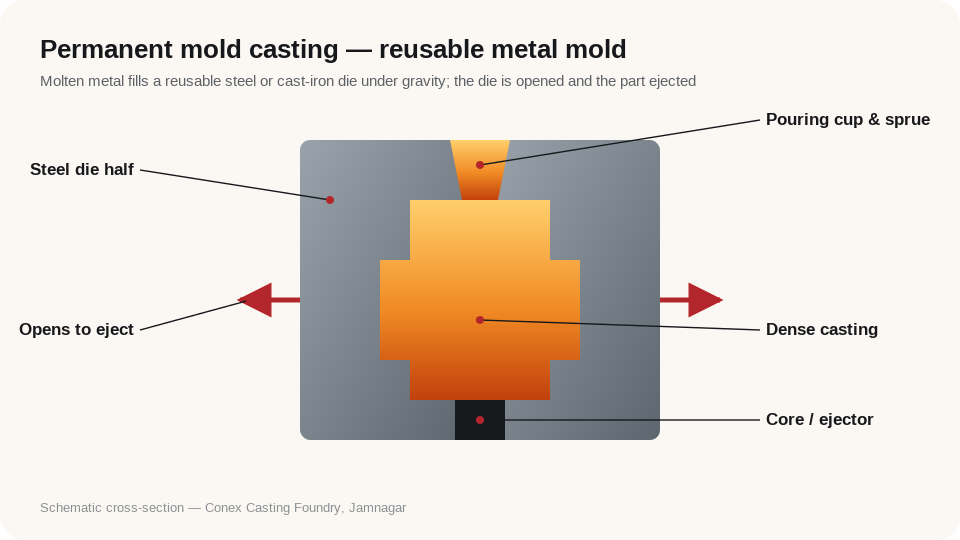
- Mold design. From your drawing we design the cavity, parting line, gating, risers, vents and ejection, and decide which internal shapes are formed by metal cores and which by sand cores.
- Mold making. The mold halves are machined from cast iron or hot-work tool steel in our tooling department.
- Pre-heating and coating. The mold is brought to working temperature and coated with a refractory dressing that controls heat flow and protects the steel.
- Core setting. Metal cores are inserted or sand cores placed; the mold is closed and locked.
- Filling. Metal at the correct grade and temperature is poured statically or by tilting the mold.
- Solidification and ejection. The casting solidifies within seconds to minutes depending on section; the mold opens and the casting is ejected.
- Finishing. Gates are trimmed, sand cores knocked out, and the casting is machined, finished and inspected.
Semi-permanent molds — metal outside, sand inside
A fully metal mold can only form shapes that can be pulled out of the casting. Many real parts — valve bodies with curved passages, fittings with internal threads, meter bodies with intricate chambers — have internal shapes that no metal core could be withdrawn from. The answer is the semi-permanent mold: a metal mold for the outside, combined with expendable sand or shell cores for the inside.
This combination gives the best of both processes. The outside of the casting has the fine-grained structure, accuracy and smooth finish of a metal mold, while the inside can be as complex as a sand casting. It is the standard method worldwide for brass plumbing fittings and valve bodies, and one we use widely for fluid-handling parts.
Mold temperature and coatings in practice
A permanent mold is a heat exchanger as much as a shape. Every casting delivers a pulse of heat into the mold, and the mold must give it up again before the next cycle. If the mold runs too cold, metal freezes before the cavity is full and leaves cold shuts and misruns; if it runs too hot, the casting solidifies slowly, shrinkage appears in heavy sections, and the metal can solder to the steel.
We manage this balance in three ways. First, the mold is designed with the right wall thickness, and, where needed, with air or water cooling behind heavy sections. Second, the cycle time is set and kept steady, because a stable rhythm keeps the mold in its temperature window. Third, the refractory coating is used as a tool: an insulating coating behind thin walls and long flow paths keeps metal liquid for longer, while a thin, conductive coating on heavy bosses draws heat away quickly so that they solidify before the sections that feed them. Getting this right is what turns a metal mold from a source of scrap into a source of consistently sound castings.
What permanent mold casting does well
- Repeatable dimensions. The mold does not change from one casting to the next, so dimensions hold within ISO 8062-3 DCTG 7–9 over long runs.
- Strength and soundness. Fast cooling against the metal wall gives a fine grain structure, higher tensile strength and better pressure tightness than the same alloy in sand.
- Good as-cast finish. Typically Ra 3.2–6.3 µm, suitable for many visible faces without machining.
- Less machining. Allowances of about 1–1.5 mm per face reduce metal and machining cost.
- Heat-treatable and weldable. Unlike high-pressure die castings, permanent mold castings contain little entrapped gas, so they can be heat treated, welded or brazed.
- Low scrap and good yield. Small gates and risers mean more of the melted metal ends up in the part.
Alloys for permanent molds
| Alloy | Designations | Typical permanent-mold parts |
|---|---|---|
| Die-casting / yellow brass | C85700, C85800, CC754S | Fittings, valve parts, connectors, hardware |
| DZR brass | CC770S type | Potable-water fittings and meter bodies |
| Silicon brass & silicon bronze | C87850, C87500, C87600 | Lead-free fittings, electrical line hardware |
| Aluminum bronze | C95200, C95400 | Bushings, wear parts, marine and valve trim |
| Copper | C81100 type | Electrical terminals and connectors (selected shapes) |
| Aluminum | A356 (LM25), LM6, AlSi7Mg | Housings, brackets, enclosures |
See each grade's datasheet in the alloy library, and the alloy × process matrix for the grades we offer by permanent mold.
Accuracy, finish and size
| Characteristic | Typical permanent-mold value |
|---|---|
| Dimensional tolerance (ISO 8062-3) | DCTG 7–9 |
| Surface roughness | Ra 3.2–6.3 µm |
| Minimum wall | about 3 mm (copper alloys), 2.5–3 mm (aluminum) |
| Draft | 1–3° external, 2–5° internal on metal cores |
| Machining allowance | about 1–1.5 mm per face |
| Typical casting weight | about 50 g to 15 kg |
Design guidelines
- Walls: keep them uniform; heavy sections next to thin ones cause shrinkage and sink marks.
- Draft: metal cores need more draft than outside walls, because the casting shrinks onto them as it cools.
- Undercuts: use sand cores, or redesign so the feature can be machined; each moving mold section adds cost.
- Radii: fillets at internal corners help the metal flow and extend mold life.
- Cosmetic faces: tell us which faces must be free of parting lines and ejector marks.
- Threads: internal threads are usually machined after casting; external threads can be cast on some parts but are normally machined for accuracy.
Comparing permanent mold with other routes
| Green sand | Permanent mold | High-pressure die | Investment | |
|---|---|---|---|---|
| Tooling cost | Low | Medium–high | Highest | Medium–high |
| Best annual quantity | 1 – thousands | Thousands – hundreds of thousands | Tens of thousands upward | Hundreds – tens of thousands |
| Tolerance | DCTG 9–12 | DCTG 7–9 | DCTG 5–7 | DCTG 4–6 |
| Internal complexity | High (sand cores) | High with sand cores | Limited | Very high |
| Soundness / heat-treatable | Good / yes | Very good / yes | Porosity risk / limited | Very good / yes |
Quality control
Permanent mold casting rewards discipline. Our ISO 9001:2015 system covers mold temperature monitoring, coating intervals, spectrometer checks of every melt, first-off dimensional approval at the start of each run, patrol inspection during production and final inspection before dispatch. Pressure and leak testing, dezincification testing for DZR brass, and proof-load tests for electrical hardware are carried out where specified. Each consignment ships with a material test certificate and inspection report — see quality and testing.
Typical permanent-mold parts
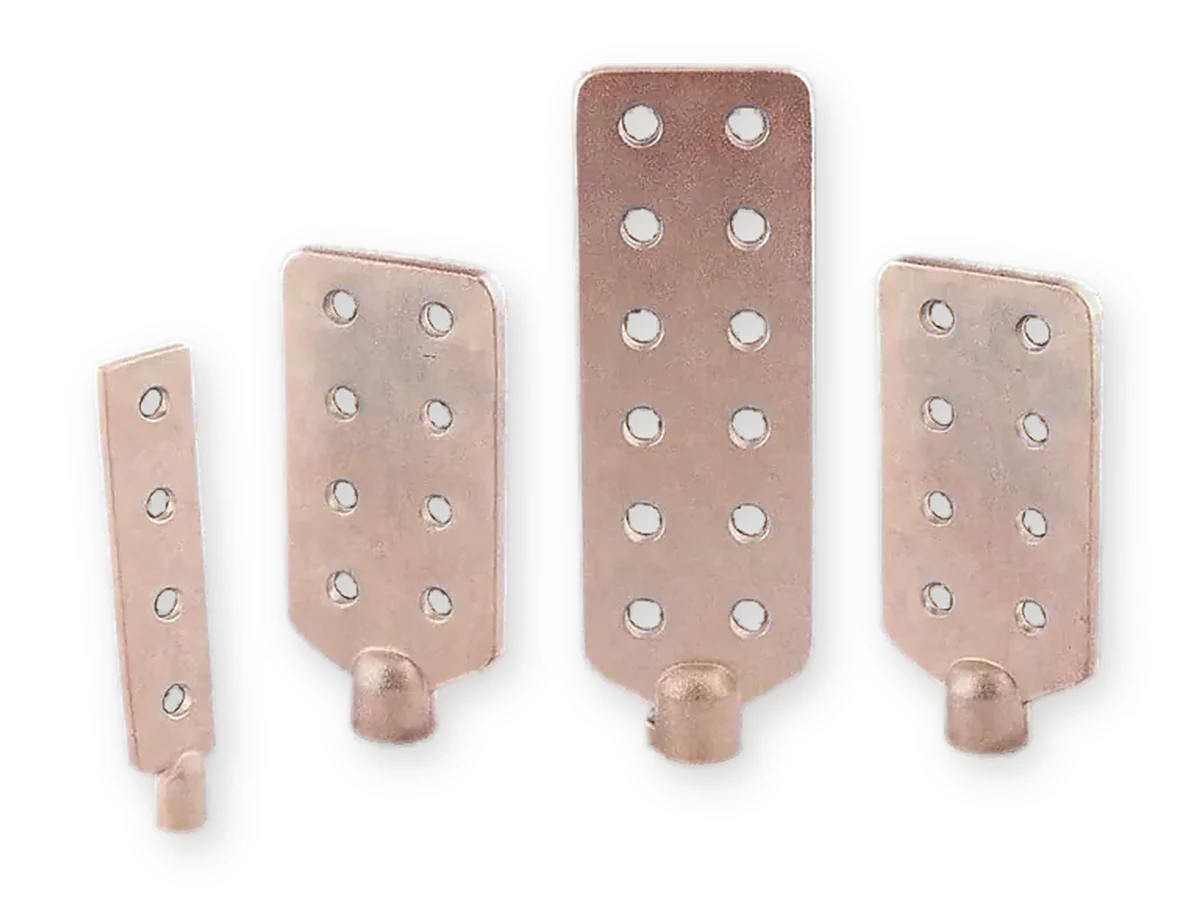
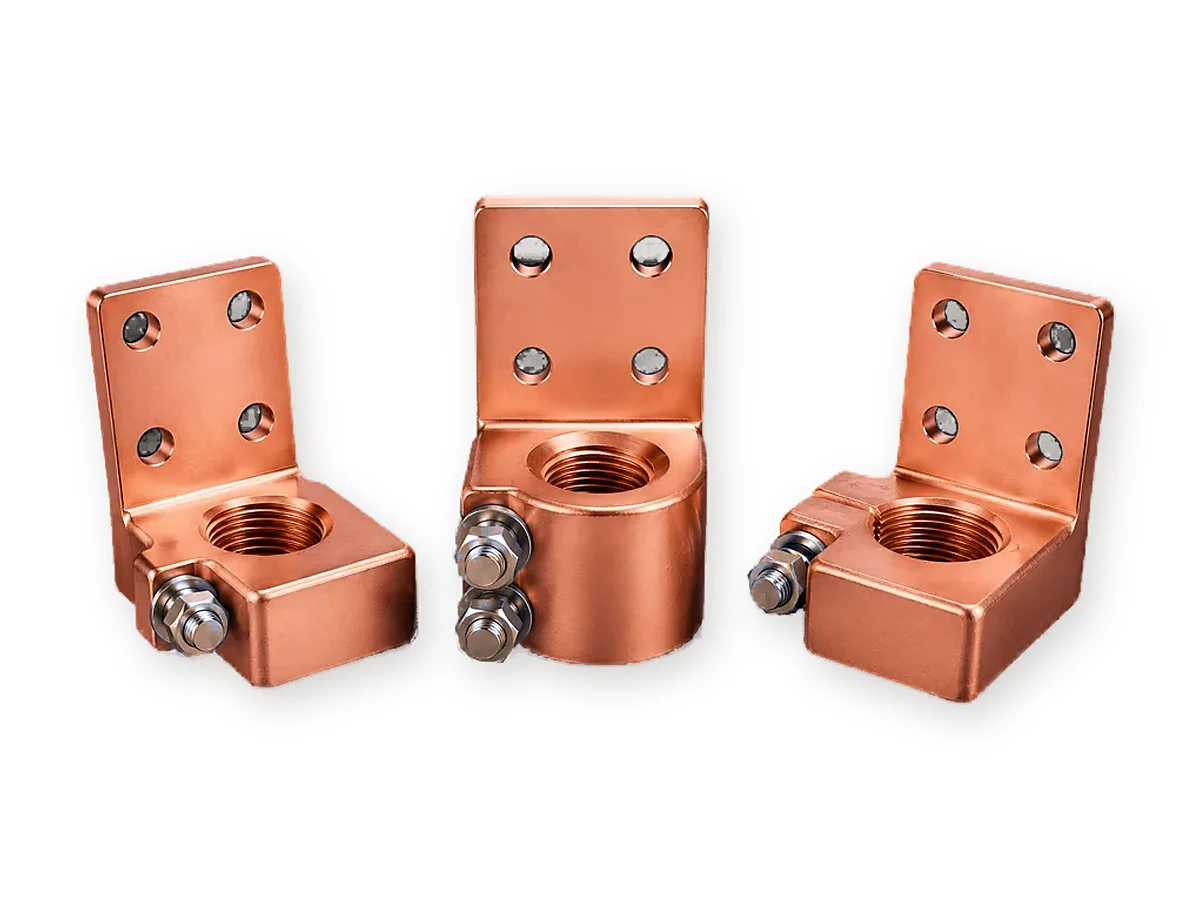
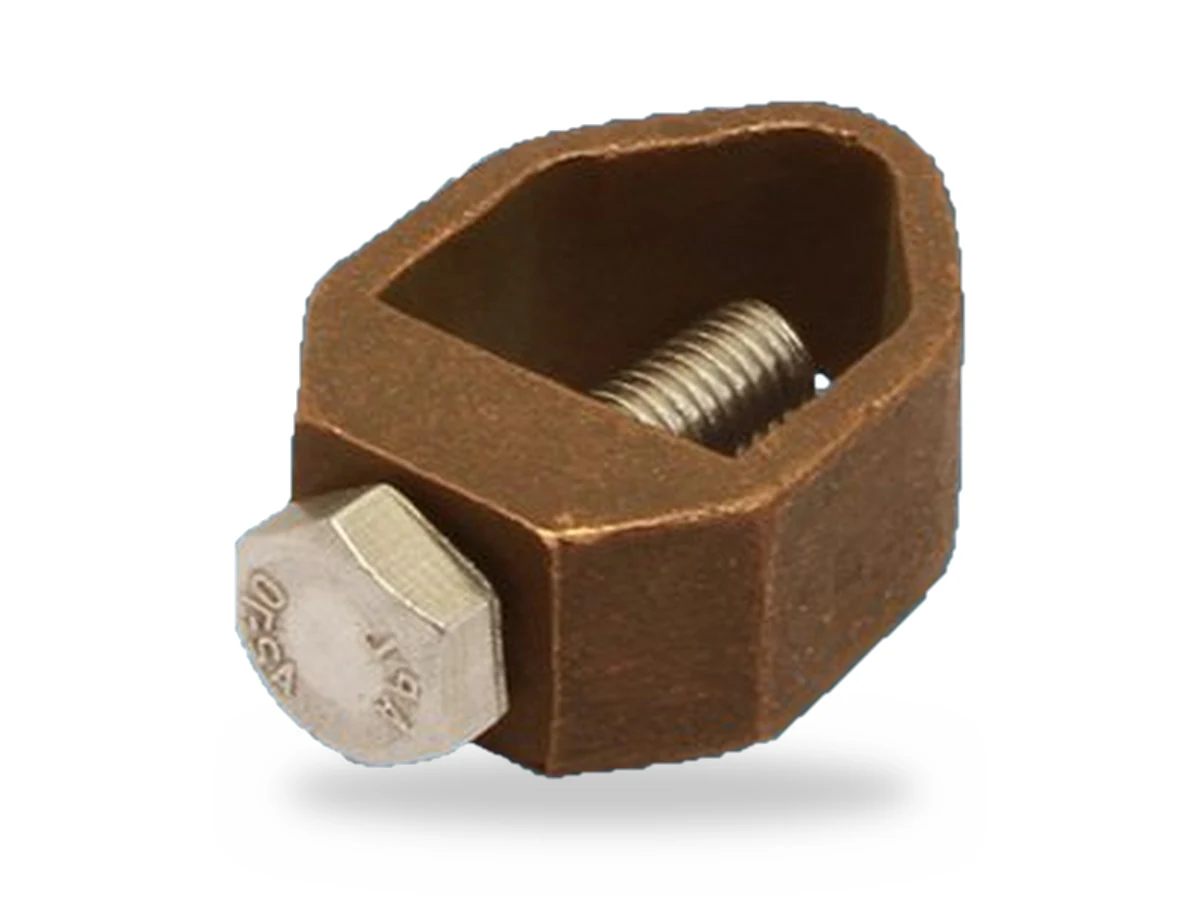
Typical applications include transformer terminals and stud connectors, earthing and grounding clamps, cable-gland bodies, plumbing and fire-fighting fittings, water-meter and regulator bodies, valve parts and aluminum housings — for electrical and transformer, power transmission, plumbing and fire protection and instrumentation customers.
Worked example: a lead-free brass meter body
A water-meter maker needs 30,000 bodies a year in a lead-free silicon brass, with an internal measuring chamber and threaded ends, leak-tight at 16 bar and certified for drinking water.
- Route: semi-permanent mold with tilt pouring — a steel mold for the outside and a shell sand core for the chamber.
- Alloy: C87850-type silicon brass, chosen for its castability and drinking-water suitability.
- Process control: mold temperature held in a narrow window; melt chemistry checked by spectrometer every heat, with lead kept below the specified limit.
- Machining: threads and sealing faces on CNC lathes using dedicated fixtures that locate on as-cast datums.
- Testing: 100% air-under-water leak test; dimensional and chemical reports with every lot.
Compared with sand casting, the metal mold gave consistent wall thickness (important for the measuring chamber), a cleaner surface, less machining and lower scrap — and the mold cost was recovered well within the first year's volume.
When not to use a permanent mold
Permanent molds are not the answer for every part. Very large castings, very small quantities, high-lead bearing bronzes, and alloys poured at very high temperatures (such as copper-nickel and stainless steel) are usually better made in sand, shell molds or by investment casting. Plain bushes and sleeves are best made by centrifugal or continuous casting. Because we offer all of these processes, our recommendation always starts from the part, not the process.
Machining and finishing permanent mold castings
Permanent mold castings are delivered machined and ready to assemble. Because the castings are dimensionally consistent, they can be located in dedicated fixtures on our CNC lathes and machining centers and machined in very few operations — facing, boring, threading, drilling cross-holes and milling flats. Consistency is the key benefit: a fixture set up for the first casting fits the ten-thousandth just as well.
After machining, parts can be deburred by vibratory finishing, polished for visible surfaces, cleaned and leak-tested for fluid parts, or sent for nickel, chrome or tin plating. Fittings for drinking water can be supplied cleaned and bagged for direct assembly. Because the as-cast surface is smooth and dense, many outer surfaces need no machining at all — reducing cost while still giving a good appearance.
Who owns the mold — and how we look after it
When you pay for a permanent mold, it is your tooling. We mark it with your part number, store it at our foundry between orders, and maintain it as part of the service. Routine maintenance includes cleaning and re-coating, polishing out fine heat-check cracks, replacing worn ejector pins and core pins, and re-machining or replacing inserts in high-wear areas. Planned maintenance keeps dimensions within tolerance over the life of the mold and avoids sudden failures in the middle of a production run.
If you already own permanent molds made elsewhere, we inspect them, check the shrinkage allowance against our alloy and practice, and refurbish them before production. Many customers have moved existing tooling to Conex in this way.
From ancient molds to modern foundries
Permanent molds are one of the oldest casting tools: stone and bronze molds were used to cast axe heads and tools thousands of years ago. The modern process — machined cast-iron and steel molds, refractory coatings, tilting machines and sand cores — grew in the twentieth century with mass production of plumbing, electrical and automotive parts. Today it remains one of the most efficient ways to produce strong, accurate copper-alloy and aluminum parts in volume, and it is the process behind most of the brass fittings in buildings around the world.
Cost and lead time
The mold is a one-time investment; the part price then reflects alloy and weight, cores, machining and testing. Permanent molds typically pay back from a few thousand pieces a year. Mold design and manufacture take about 4–6 weeks after drawing approval, followed by samples for your approval. We quote mold and part prices separately, and we keep your molds maintained and ready for repeat orders.
Permanent mold casting — quick answers
Is permanent mold the same as die casting?
It is the same as gravity die casting. It is not the same as high-pressure die casting, where metal is injected at high speed and pressure into a hardened steel die.
Can permanent mold castings be plated?
Yes. Their dense, smooth surface takes nickel, chrome and tin plating well after machining and polishing.
Do you offer lead-free alloys for permanent molds?
Yes — silicon brass, silicon bronze and DZR brass options are available for drinking-water and food-contact parts.
What volumes justify a permanent mold?
Typically a few thousand pieces a year or more. Below that, sand or shell molding is usually cheaper overall; we show both prices when the decision is close.
Can the same mold make parts in different alloys?
Sometimes. Alloys with similar shrinkage and pouring temperatures can share a mold; otherwise the shrinkage allowance differs and a separate mold or inserts are needed.
Request a quotation
Send your drawing, alloy, annual quantity and testing needs through our quotation form or WhatsApp. We will confirm whether a permanent mold pays back for your volume and quote mold and part prices clearly.
Alloys we cast by permanent mold casting
● dedicated pages first.
Other processes
Industries served
Product families made by permanent mold casting
Questions buyers ask
Is permanent mold casting the same as gravity die casting?+
Yes — it is the North American name for the same process; copper-alloy permanent mold castings are covered by ASTM B806.
What is a semi-permanent mold?+
A metal mold for the outside of the part combined with sand or shell cores for internal passages — the standard method for brass plumbing and valve bodies.
Are permanent mold castings stronger than sand castings?+
Usually yes: faster cooling against the metal mold gives finer grain, higher strength and better pressure tightness in the same alloy.
Send your drawing, get a quotation.
DWG, PDF, STEP or a sample photo — with quantity and destination port.