
27 alloys
Green Sand Casting
Moist clay-bonded (green) sand molds — the most economical sand route for medium and large bronze and brass parts in short and medium runs.
Green Sand Casting — complete guide
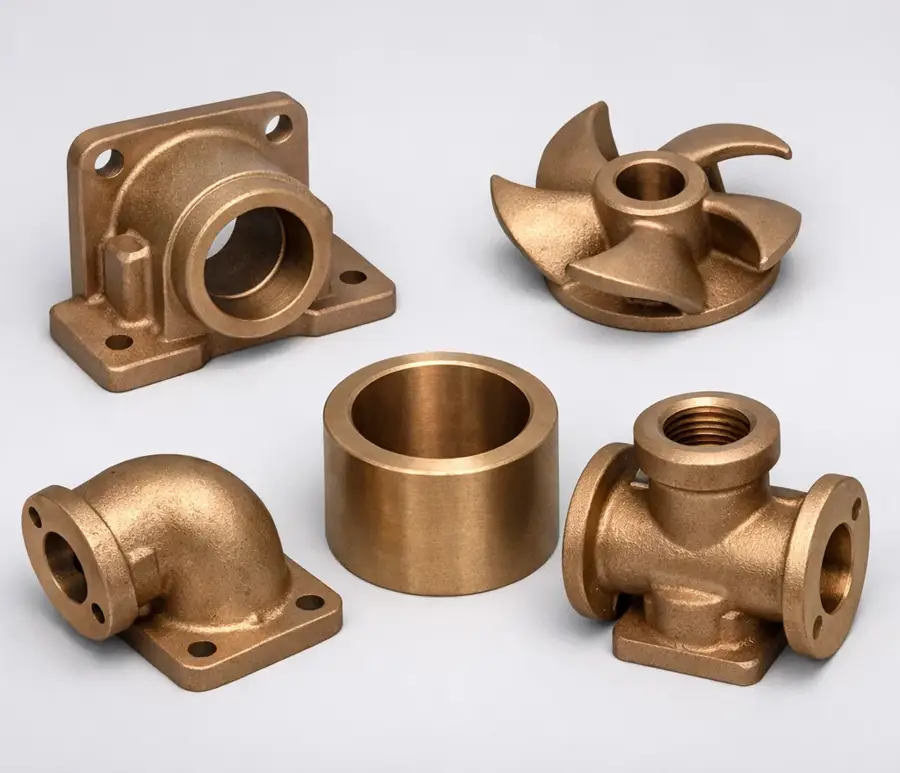
Green sand casting is the most economical way to make medium and large bronze and brass parts in short and medium runs. The "green" has nothing to do with color: it means the molding sand is used moist, bonded by clay and water, and is never baked or chemically hardened. The mold is rammed, the pattern is drawn, metal is poured within hours — and afterwards the same sand is reconditioned and used again. At Conex Casting Foundry in Jamnagar, green sand is our workhorse route for valve bodies, pump parts, flanges, marine fittings, bushes and earthing hardware in gunmetal, tin bronze, brass, silicon bronze and aluminum bronze.
This page explains what green sand is, how a green sand mold is made and controlled, which parts and alloys suit it, what accuracy and finish you can expect, and how it compares with no-bake sand, shell molding and permanent mold casting.
What is green sand?
Green sand is a carefully balanced mixture of four ingredients:
| Ingredient | Typical share | Purpose |
|---|---|---|
| Silica sand | about 85–90% | The refractory body of the mold; grain size sets the surface finish and permeability |
| Bentonite clay | about 5–10% | The binder — when moistened, clay coats the sand grains and holds them together |
| Water | about 2–4% | Activates the clay; too little gives a weak mold, too much gives steam and gas defects |
| Additives | small amounts | Carbonaceous additives or cereal binders improve surface finish and help the mold collapse after casting |
Because the binder is clay rather than resin, green sand needs no curing time, gives off very little fume and can be reused almost indefinitely. A small proportion of new sand and bentonite is added to every batch to replace what is lost, keeping the properties stable. This recycling is what makes green sand both the cheapest and one of the most sustainable ways to cast metal.
In European standards, sand castings — green or chemically bonded — carry the suffix -GS after the EN 1982 designation (for example CC491K-GS for gunmetal). In the USA, green sand castings are supplied to the sand-casting specifications ASTM B584, ASTM B62 and ASTM B763.
How green sand casting works

- Sand preparation. Returned sand is cooled, screened and mixed in a muller with fresh bentonite, water and additives until it reaches the target moisture and strength.
- Pattern placement. The pattern (or a match plate carrying both halves) is placed in the flask, with the gating system and risers attached or cut in.
- Ramming. Sand is compacted around the pattern — by hand rammers for larger work or by jolt-squeeze molding for repeat parts. Even, firm ramming gives a hard mold face and accurate dimensions.
- Pattern draw. The flask is lifted off the pattern, leaving a clean cavity. Draft on the pattern walls lets it release without tearing the sand.
- Core setting and closing. Baked or resin-bonded cores are set into their prints, the cope is closed onto the drag and the mold is weighted or clamped.
- Pouring. Metal melted to your grade is poured within hours of molding, while the mold is still "green".
- Shake-out. After solidification the mold is broken on a vibrating grid; the sand goes back to the preparation plant and the casting goes to fettling.
- Fettling, machining and inspection. Gates and risers are removed, the casting is shot blasted, machined on CNC and inspected.
Controlling the sand — why it matters
A green sand foundry is only as good as its sand control. The same mixture that makes a perfect casting one day can make a scrap casting the next if moisture drifts or clay is burned out. We test the prepared sand regularly for the properties that matter most:
- Moisture — too much water creates steam at the metal face, causing blowholes and rough surfaces.
- Compactability — shows whether the sand is in the right "temper" for molding.
- Green compression strength — the mold must hold its shape under the weight and pressure of molten metal.
- Permeability — gases from the metal and cores must escape through the sand rather than into the casting.
- Grain fineness — finer sand gives a smoother finish; coarser sand gives better permeability. We choose the grade to suit the alloy and section size.
Mold hardness is checked on the mold face before closing. These simple, disciplined checks are what keep surface defects, sand inclusions and gas porosity under control — and they are part of our ISO 9001:2015 quality system.
Which parts suit green sand casting?
Green sand is the first choice when a part is:
- Small to large — from a few hundred grams to castings weighing many tens of kilograms;
- Needed in modest quantities — a few pieces to a few thousand pieces a year;
- Of moderate complexity — with internal passages formed by cores;
- Going to be machined on its functional faces anyway, so the as-cast tolerance is less critical.
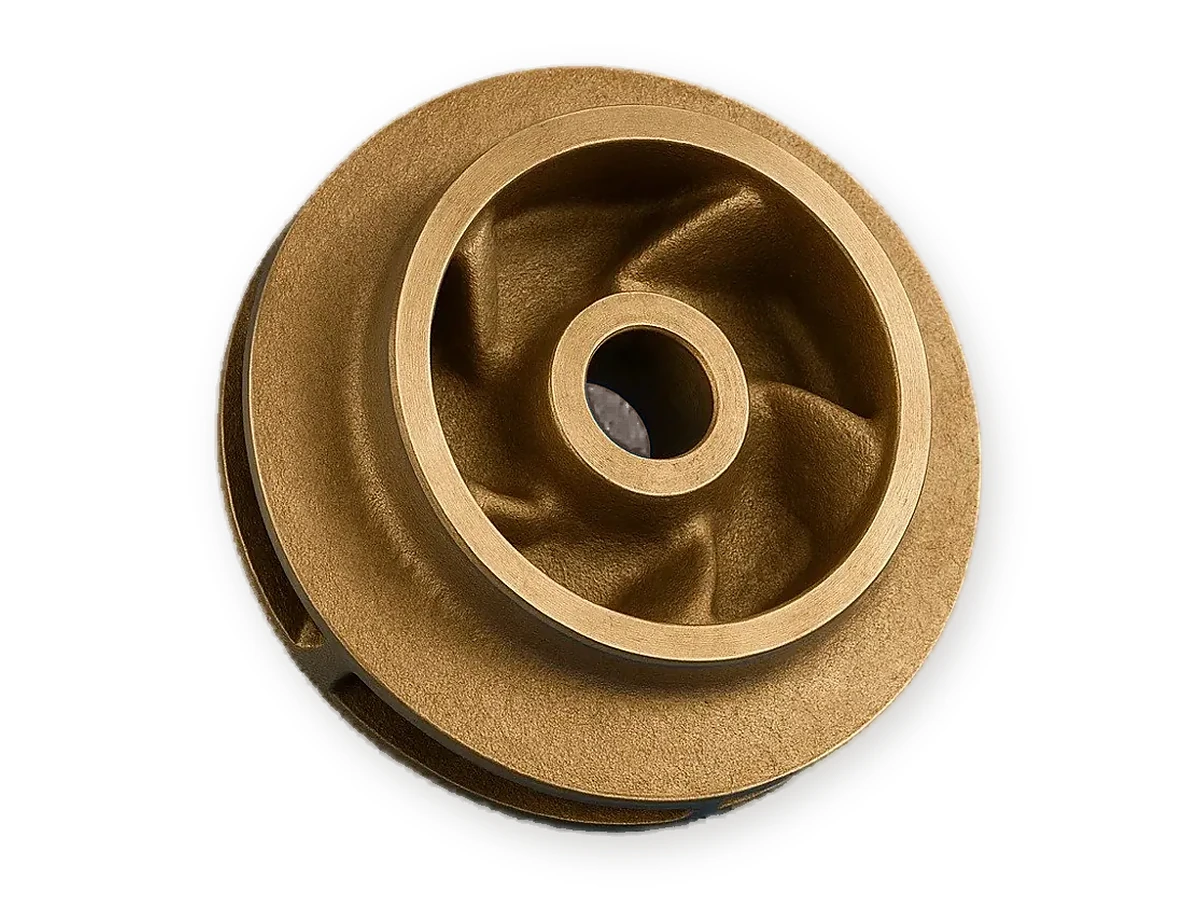
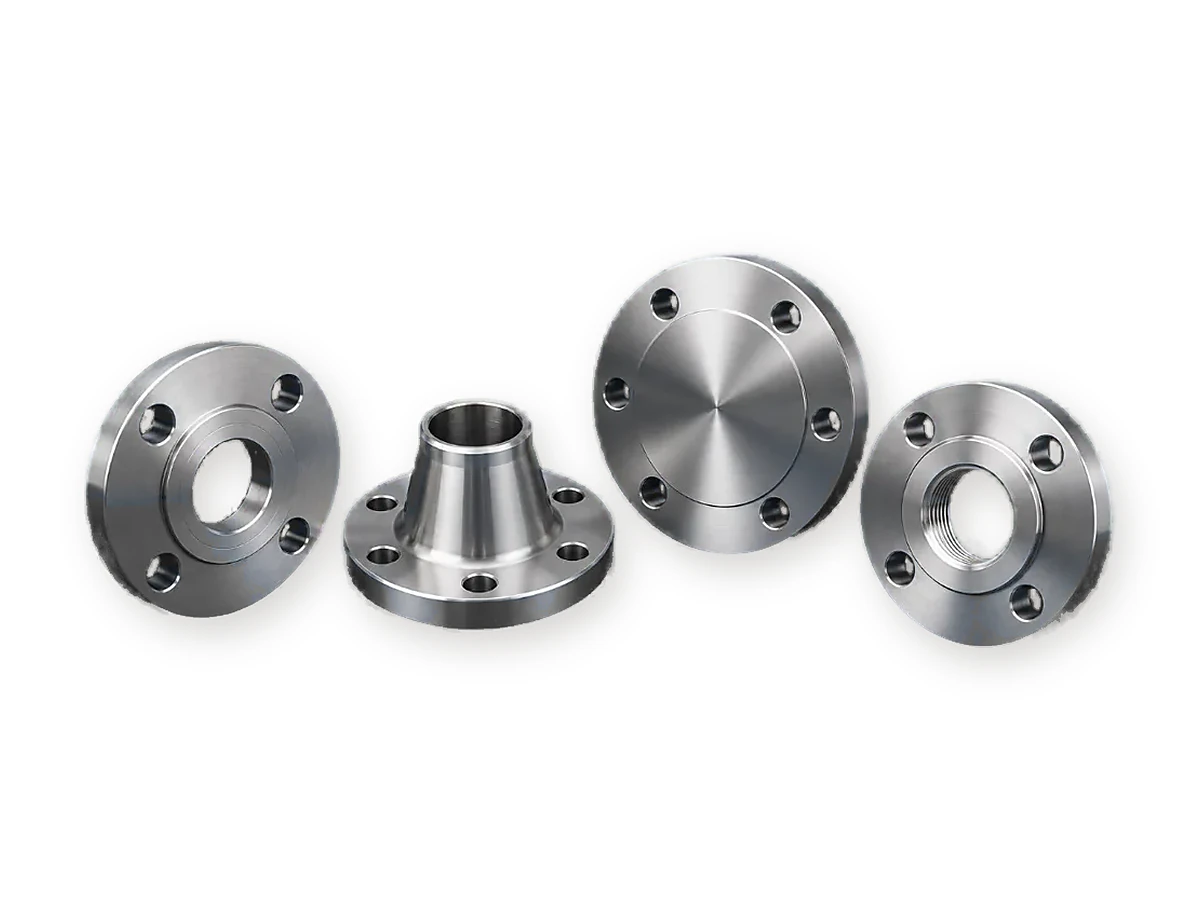
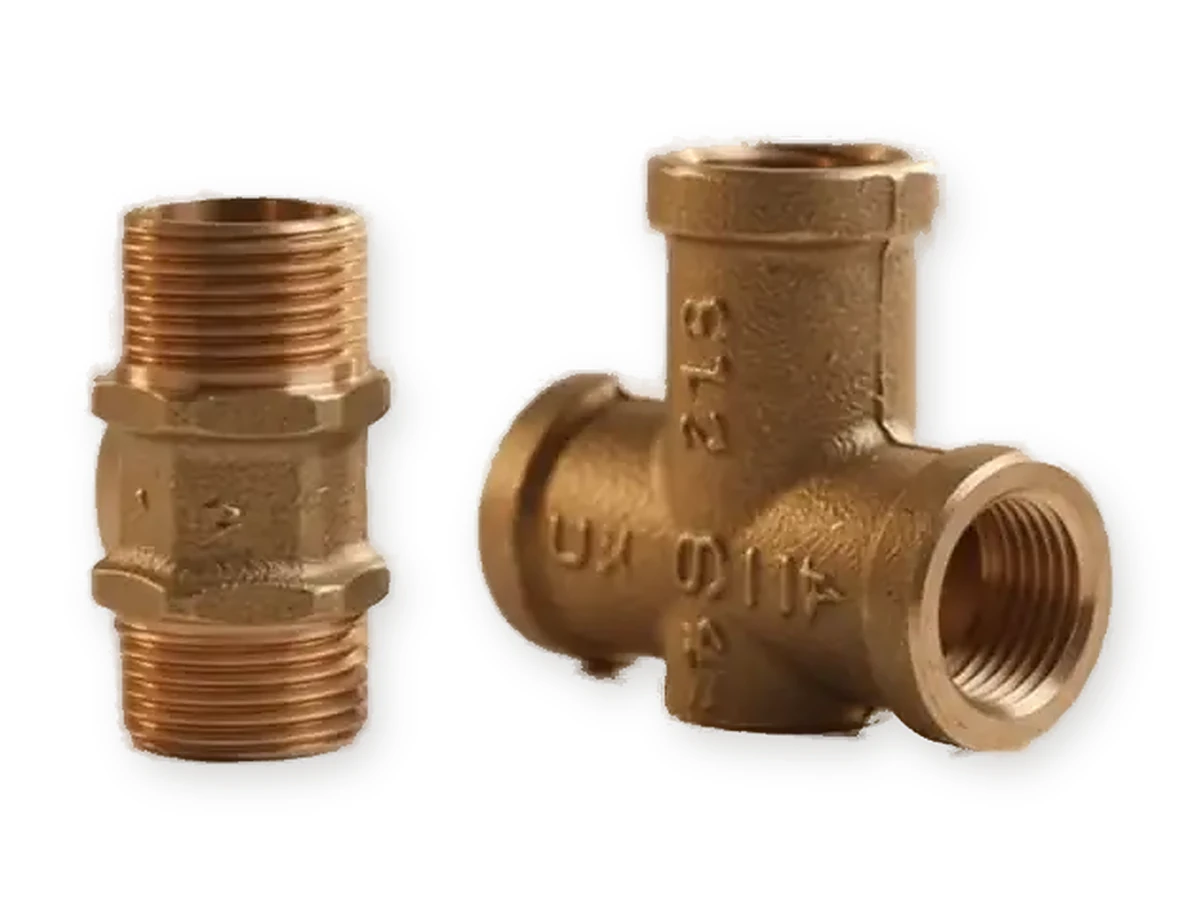
Very heavy castings, parts with thick sections that need maximum mold rigidity, and parts that must be exceptionally pressure-tight are often better made in no-bake (resin) sand — see our sand casting guide for the full range of sand methods.
Alloys we cast in green sand
| Alloy | Common designations | Typical green-sand parts |
|---|---|---|
| Leaded gunmetal / red brass | C83600 (85-5-5-5), LG2, CC491K, C84400 | Valve bodies, pump bodies, water fittings, flanges |
| Tin bronze | C90300, C90500, PB1, CC480K | Gear blanks, marine fittings, pump parts |
| Leaded bearing bronze | C93200 (SAE 660), LB2, CC495K | Bushes, bearings, wear plates |
| Silicon bronze | C87600, C87500 | Marine hardware, electrical fittings, lead-free parts |
| Yellow and high-tensile brass | C85700, C86300, HTB1 | Hardware, structural parts, valve stems |
| Aluminum bronze | C95400, AB1, AB2 | Impellers, valve trim, wear parts |
Aluminum bronze is more sensitive to moisture and turbulence than tin bronze, so for critical aluminum-bronze parts we often use bottom gating with ceramic filters, or move to no-bake sand. You will find full datasheets for each grade in our alloy library.
Accuracy and surface finish
| Characteristic | Typical green-sand value |
|---|---|
| Dimensional tolerance (ISO 8062-3) | DCTG 9–11 machine molded · DCTG 10–12 hand molded |
| Surface roughness | Ra 6.3–12.5 µm with fine sand; up to 25 µm on large castings |
| Minimum wall | about 4 mm (3 mm for small, simple sections) |
| Draft | 1–2° on external walls, 2–3° on internal walls and deep pockets |
| Machining allowance | 2–4 mm per face for small and medium parts |
| Linear shrinkage allowance | about 1.3–1.6% (brass, gunmetal, tin bronze) · about 2% (aluminum bronze) |
All functional faces, bores, threads and sealing surfaces are machined on our CNC machines after casting, so your finished part meets the drawing tolerance — typically ±0.05 mm or better on machined features.
Green sand compared with other molding methods
| Green sand | No-bake (resin) sand | Shell molding | Permanent mold | |
|---|---|---|---|---|
| Binder | Clay + water | Chemical resin | Heat-cured resin | None — metal mold |
| Mold cost per casting | Lowest | Medium | Medium | Lowest at volume |
| Tooling cost | Low (wood/resin pattern) | Low | Medium (heated metal pattern) | High (metal die) |
| Best batch size | 1 – thousands | 1 – hundreds | Hundreds – tens of thousands | Thousands upward |
| Best part size | Small – large | Medium – very large | Small – medium | Small – medium |
| Surface finish | Good | Good | Very good | Very good |
See also shell molding and permanent mold casting, or compare all routes on our casting processes page.
Designing for green sand
- Uniform sections: keep walls as even as possible and transition gradually between thick and thin.
- Radii: use fillets at internal corners — sharp corners erode the sand and cause hot spots.
- Draft: allow draft on all walls parallel to the pattern draw; deep pockets need more.
- Deep narrow pockets: avoid sand "fingers" that are tall and thin — they can break or wash away. Make them cores instead.
- Lettering and logos: raised lettering on the casting is easy; keep it at least 1 mm high and simple in form.
- Datums: show the machining datums on the drawing, so first-operation fixturing is reliable.
Hand molding, machine molding and match plates
Green sand molds can be made in several ways, and we choose the method by part size and quantity:
Hand (floor) molding
Large castings, one-off parts and short runs are rammed by hand or with pneumatic rammers in large flasks or on the foundry floor. It needs skilled molders but almost no special tooling, so it is ideal for prototypes and heavy parts.
Jolt-squeeze machine molding
For repeat parts, a molding machine jolts the flask to settle the sand and then squeezes it to a uniform hardness. Molds are faster to make and more consistent, giving closer dimensions batch after batch.
Match plates
Both halves of the pattern are mounted on opposite sides of a single plate, with the gating system attached. Cope and drag are molded from the same plate, so they always align — the efficient choice for small parts in hundreds or thousands.
Several small parts can share one mold ("multi-cavity" molding), which reduces the cost per piece significantly for items such as clamps, lugs, small fittings and bushes.
Choosing the pattern material
The pattern is your one-time tooling investment, so it should match the life of your product:
| Pattern material | Typical life | Best for |
|---|---|---|
| Wood | Hundreds of molds | Prototypes, large parts, low quantities |
| Polyurethane / epoxy resin | Thousands of molds | Medium quantities, good dimensional stability |
| Aluminum or cast iron | Tens of thousands of molds | Machine molding and long-running repeat parts |
Patterns made by our in-house tooling department remain available for your repeat orders. If you already own patterns, we inspect them for shrinkage allowance and wear before casting.
Melting and pouring practice
Green sand is forgiving, but the metal is not. Most porosity in bronze castings comes from the melt, not the mold. Our melting practice includes:
- Clean charge materials — certified ingot and graded returns, so the composition matches your standard.
- Induction melting — fast, controlled melting that limits gas pick-up and zinc or tin loss.
- Composition check — a spectrometer sample is taken from each melt and corrected if necessary before pouring.
- Deoxidation and degassing — phosphor-copper or other deoxidizers for tin bronzes and gunmetals; fluxing and careful handling for aluminum bronze.
- Pouring temperature control — hot enough to fill thin sections without cold shuts, cool enough to avoid sand burn-on and gas pick-up.
- Test bars — cast from the same melt when mechanical properties must be certified.
Worked example: a gunmetal valve body in green sand
To show how the process comes together, here is how a typical order moves through our foundry — a 6 kg gunmetal (C83600 / LG2) gate-valve body, 500 pieces a year, hydro-tested to 16 bar.
- Review. The customer's drawing shows flanged ends, a central bonnet face and an internal flow passage. Our engineers mark the parting line through the flange centers, design one sand core for the passage, and add 3 mm machining allowance on flange and bonnet faces.
- Tooling. A resin match plate with two cavities and a core box are made in our tooling department. Two bodies are cast per mold to halve the molding cost per piece.
- Method. Metal enters through a bottom gate into the thinner flange, and a riser sits on the heavy bonnet boss, so solidification runs from the flanges toward the riser — giving a sound, pressure-tight body.
- Samples. The first castings are sectioned through the bonnet boss and hydro-tested at 1.5 times working pressure. The method is approved.
- Production. Each batch is melted to C83600 composition, checked by spectrometer, poured, shaken out and fettled. Bodies are CNC-machined — flange faces, bonnet seat and threads — then 100% hydro-tested.
- Dispatch. The batch ships with a material test certificate, pressure-test record and dimensional report, in export packing.
The same logic — method first, then controlled sand and metal, then machining and testing — applies to every green sand part we make, from a 300 g earthing clamp to a large pump casing.
Green sand or no-bake sand — how we decide
Both are sand casting, but they behave differently. Green sand is faster and cheaper per mold and suits most bronze and brass parts. No-bake (chemically bonded) sand produces a rigid mold that does not move under metal pressure, which helps when:
- the casting is large or heavy and the green mold would bulge under the metal head;
- sections are thick and the casting needs long solidification time in a stable mold;
- the part has tight as-cast tolerances on unmachined surfaces;
- the alloy is poured hot, such as copper-nickel or stainless steel;
- quantities are very low and a loose wooden pattern is used without a flask.
We make that decision for you after reviewing your drawing — and it is reflected in the quotation, so you are never paying for a more expensive route than your part needs.
Defects we prevent — and how
| Defect | Usual cause | How we prevent it |
|---|---|---|
| Blowholes, pinholes | Excess moisture, poor venting, gassy melt | Moisture control, venting, melt degassing |
| Sand inclusions, erosion | Weak mold, turbulent metal stream | Green strength control, gating design, filters |
| Shrinkage porosity | Insufficient feeding of heavy sections | Riser design, chills, directional solidification |
| Rough or burnt-on sand | Coarse sand, high pour temperature | Correct sand grade, temperature control, mold coatings |
| Mismatch / shift | Cope and drag misaligned | Accurate flask pins and closing practice |
| Cold shuts, misruns | Metal too cold or too slow | Pouring temperature and rate control |
Where your application requires it, we add pressure testing, dye-penetrant testing, radiography or third-party inspection. Material test certificates and inspection reports are supplied with each consignment — see quality and testing.
Why green sand is a sustainable choice
Green sand is one of the most resource-efficient ways to make metal parts. More than 90% of the molding sand is reused after every cast; the clay binder is natural, and no chemical curing agents are needed. Metal from gates and risers goes straight back into the furnace as revert. Combined with in-house machining — which means castings travel only once — green sand casting keeps both cost and footprint low.
Industries that rely on green sand castings
Green sand castings from Conex are used in pumps and valves, marine and shipbuilding, plumbing and fire protection, water and chemical plants, power transmission and distribution, railways and agricultural machinery and irrigation. In each of these, buyers value the same things: a sound, pressure-tight casting, a reliable alloy certificate and a part that arrives machined and ready to assemble.
Cost and lead time
The cost of a green sand casting is driven by the alloy and casting weight, the number of cores, fettling and machining time, the quantity (patterns are shared across the batch), and any testing requirements. For new parts, pattern making and samples typically take 2–4 weeks after drawing approval. Repeat orders are produced against your delivery schedule, and we can hold patterns for you at our foundry for future batches.
Use our weight estimator to calculate casting weight from your dimensions, and the alloy selector to compare grades by cost, machinability and conductivity.
Green sand casting — quick answers
Is green sand casting suitable for stainless steel?
Stainless steels are poured at much higher temperatures than copper alloys, and are generally better made by no-bake sand, shell molding or investment casting. For bronze, brass and gunmetal, green sand is ideal.
How many castings can one pattern make?
A good wooden pattern makes hundreds of molds; resin and aluminum patterns make thousands. We maintain and repair the patterns we hold for repeat customers.
Can green sand castings be pressure-tight?
Yes — gunmetal and tin-bronze valve and pump bodies are routinely green sand cast and hydro-tested. For the most demanding pressure parts we may recommend no-bake sand or centrifugal casting.
What information helps you quote faster?
The drawing with tolerances and machined faces marked, the alloy standard, annual quantity and batch size, and the test documents you need. If the part replaces an existing one, a photo or sample helps us understand the application.
Can you change the design after samples?
Yes. Wood and resin patterns are easy to modify, which is one reason green sand suits development projects: we adjust the pattern, recast samples and move to production when you approve.
Request a quotation
Send your drawing (PDF and STEP/IGES if available), the alloy or standard, quantity, and any machining, testing or documentation requirements through our quotation form or on WhatsApp. Our engineers will confirm whether green sand is the right route and send a clear quotation, with samples on request.
Alloys we cast by green sand casting
● dedicated pages first.
Other processes
Industries served
Product families made by green sand casting
Questions buyers ask
What size of parts can be sand cast?+
Sand casting suits everything from small fittings to heavy pump casings; share the part weight and size and we confirm the molding route.
Is sand casting good for small quantities?+
Yes — pattern cost is low, so it is the most economical route for prototypes and small or medium batches.
What finish does sand casting give?+
A slightly textured as-cast surface; faces that need accuracy are machined. Shell molding gives a smoother finish where needed.
Send your drawing, get a quotation.
DWG, PDF, STEP or a sample photo — with quantity and destination port.